
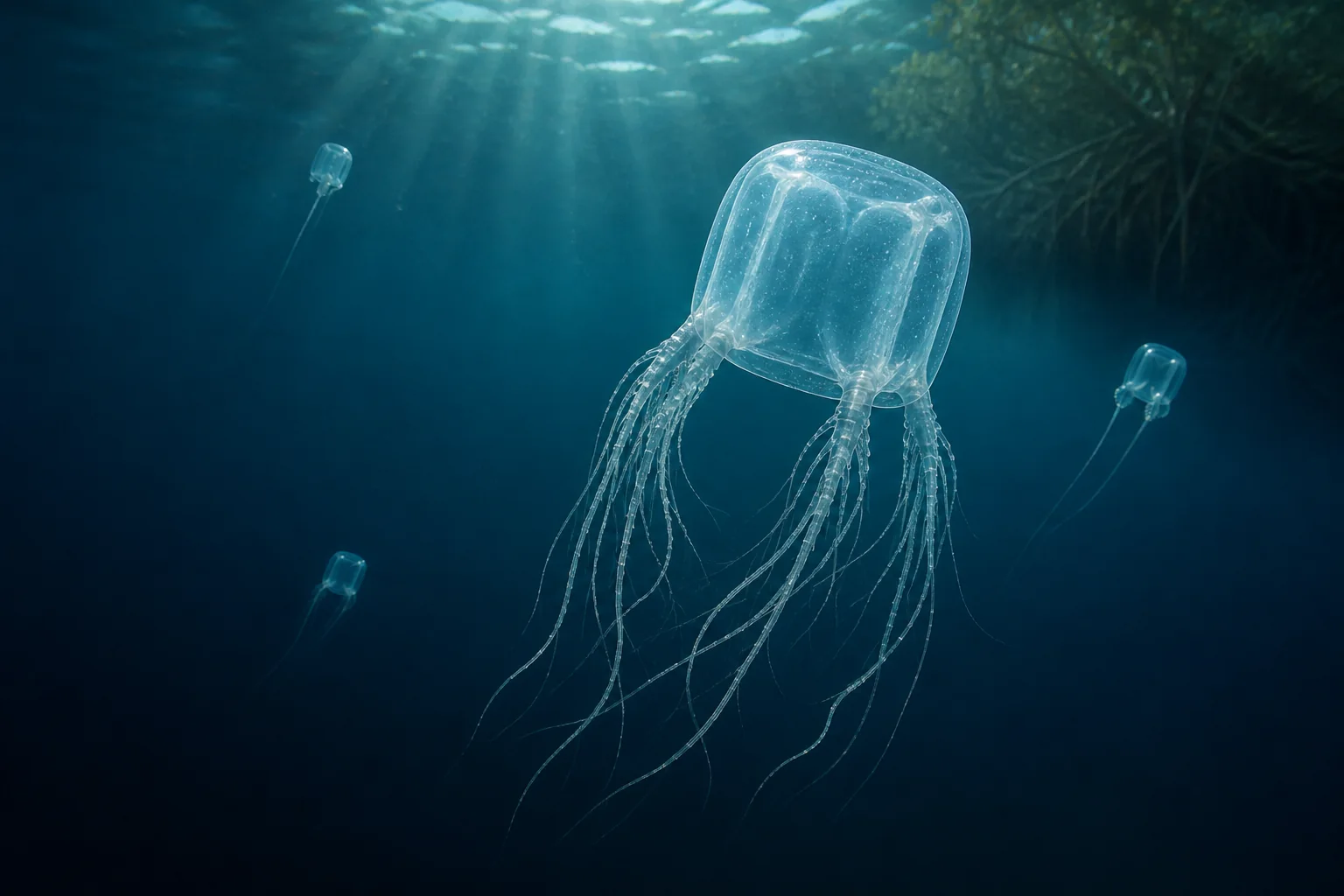
Box jellyfish occur in tropical, subtropical and some temperate marine waters around the world. Their distribution is a patchwork of species, habitats and observation quality—not one continuous “box jellyfish zone.” The large species best known for rapidly life-threatening stings are concentrated mainly in the Indo-Pacific, while other cubozoans occur in the Atlantic, Mediterranean and eastern Pacific.
Box jellyfish distribution by region
| Region | Representative cubozoans | What the record means | Local guide |
|---|---|---|---|
| Tropical northern Australia | Chironex fleckeri, Carukia barnesi, Morbakka fenneri and other Irukandji-associated species | The best-documented region for severe Chironex and Irukandji risk. Timing and controls vary among jurisdictions. | Australia season guide |
| Western Pacific | Chironex yamaguchii and other records under taxonomic review | Medically important multi-tentacled box jellyfish occur, but an animal should not be assigned the Australian name C. fleckeri without evidence. | Philippines guide |
| Thailand and nearby Southeast Asian coasts | Several multi- and single-tentacled cubozoans | Serious incidents are documented. Current Thai beach and emergency guidance takes precedence over a borrowed Australian calendar. | Thailand guide |
| Japan, including Okinawa | Chironex yamaguchii | Verified occurrence and medical significance require local Japanese warnings and current taxonomic evidence. | Species profile |
| Hawaii | Alatina alata and other cubozoans | Some near-shore appearances follow a studied lunar pattern on particular shores; the calendar is not a universal absence guarantee. | Hawaii guide |
| Western Atlantic, Gulf of Mexico and Caribbean | Chiropsalmus quadrumanus, Carybdea xaymacana, Alatina species | Box jellyfish are present, but the species and public-health pattern are not identical to tropical Australia. | Florida and Caribbean guide |
| Mediterranean | Carybdea marsupialis, Copula lucentia | Current taxonomy has replaced some older “worldwide” identifications and added newly described diversity. | Mediterranean species |
Habitats used by different box jellyfish
Shallow beaches, bays and estuaries
Large Chironex species and some relatives use warm sheltered coastal water, including areas influenced by creeks, estuaries and mangroves. Rain, tide, salinity, wind and prey can affect encounters locally, but no single condition predicts every species or coast.
Mangrove lagoons
Small visual specialists such as Tripedalia cystophora occupy structured mangrove habitats. Their distribution cannot be inferred from the coastal habitat of a large Australian Chironex.
Reef edges and open ocean
Alatina species can spend much of their lives offshore and move near shore for reproductive aggregations. Near-shore counts therefore reveal only part of their range and life cycle.
Tidal creeks are not freshwater lakes
Cubozoans are marine animals. Some tolerate brackish estuarine conditions and may travel into tidal rivers or creek mouths, but that is not evidence of an established landlocked freshwater population. Read the detailed explanation of fresh water versus estuarine habitat.
Why distribution maps disagree
- Names change. Taxonomists describe new species, split broad historical names and re-examine preserved type specimens.
- Transparent animals are missed. Survey methods and effort differ, and polyps are tiny and easily overlooked.
- Photographs have limits. Fine internal anatomy or DNA may be required to distinguish close relatives.
- Old records may be too broad. A label once applied worldwide may now represent several regional species.
- Public reports are uneven. More attention, phones and monitoring can produce more records without proving the population increased.
- Range is not risk. A verified specimen record does not state how often swimmers encounter the species or how severe its typical sting is.
How we judge a range claim
A high-confidence record should provide an accepted current name, date and precise locality, photographs of the fresh animal when possible, diagnostic anatomy and ideally a voucher specimen held by a recognized collection. Molecular data are especially useful when visually similar populations may hide separate lineages. The World Register of Marine Species is used to check accepted names, while museum specimens and primary research support locality claims.
| Evidence | Confidence | Limitation |
|---|---|---|
| Voucher specimen, diagnostic anatomy and DNA | High | Still depends on correct reference data and current taxonomy |
| Expert-verified specimen or diagnostic photographs | Moderate to high | Some species cannot be separated from photographs |
| Clear public photograph with date and coordinates | Provisional | Useful lead, not always a species-level record |
| Undocumented memory or reposted image | Low | Locality, date and identity may all be wrong |
Is climate change moving box jellyfish?
Warming, currents, rainfall, oxygen and food-web change can alter suitable habitat, but “more box jellyfish everywhere” is not supported as a universal conclusion. Range change must be demonstrated with repeated species-level observations and comparable sampling. See the evidence review on climate change and box jellyfish.
What swimmers should do with this information
- Use this guide to understand which species groups are documented in a region.
- Check the responsible local authority for today’s closure, warning and first-aid protocol.
- Choose patrolled or managed swimming locations.
- Wear full-coverage protective clothing where local authorities recommend it.
- Know the emergency number and read the sting symptoms and first-aid guide before entering risk areas.
Sources and methodology
- World Register of Marine Species
- NOAA National Ocean Service: box jellyfish
- Smithsonian Ocean: jellyfish and comb jellies
- Australian Museum: box jellyfish
Editorially reviewed: 22 August 2026. Taxonomy and distribution change as new evidence appears; locality pages should be checked against current authorities before travel.
Evidence-coded global range map
This schematic maps documented regional records, not “safe” and “unsafe” ocean. Select a marker to jump to its evidence note. Coastlines are simplified and should not be used for navigation or beach-level risk.
Key: ● verified · ◆ historical/renamed · ▲ uncertain or unresolved
N Australia
SE Asia
Japan
Hawaii
W Atlantic
Mediterranean
photo-only/global claims
Northern Australia — verified
Voucher, ecological and medical literature document several cubozoans. The range of Chironex fleckeri should not be copied wholesale onto other oceans.
Southeast Asia — verified but taxonomically active
Thailand alone has multiple documented species. Singapore and regional taxonomic work continue to revise which names apply.
Japan/Okinawa — verified
Chironex yamaguchii is medically important and distinct from assuming every large animal is C. fleckeri.
Hawaii — verified, site-specific pattern
Alatina aggregations have a studied lunar pattern at particular shores; this is not a global calendar.
Western Atlantic and Caribbean — verified
Records include Chiropsalmus quadrumanus, Alatina and carybdeids; species and public-health patterns differ by jurisdiction.
Mediterranean — verified animals, historical names under review
Older “worldwide” identifications have been revised, and new diversity such as Copula lucentia has been described.
Method sources include Alatina alata phylogeography, Thai Chironex identification, and the site’s linked regional taxonomic sources. Last evidence-map review: 22 August 2026.
Review and corrections
See an error or outdated source? Read our corrections process. Safety information is educational and does not replace local emergency services or clinical advice.