
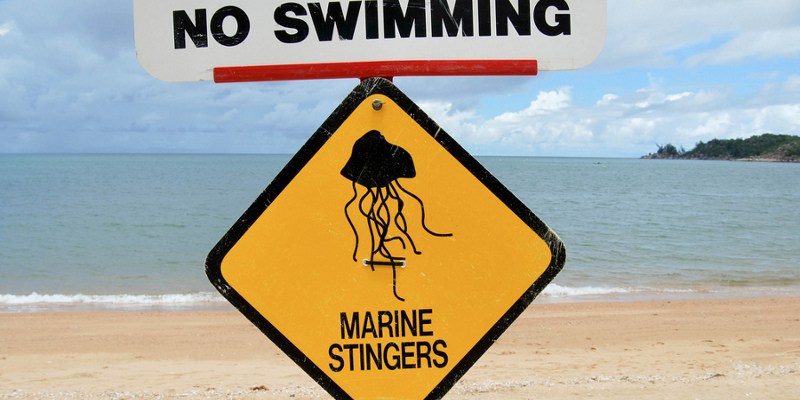
In tropical northern Australia, box jellyfish risk is highest during the warm, wet “stinger season,” but exact timing varies by region and stings can occur outside the headline dates. Always use current local warnings rather than a national calendar alone.
Northern Territory
The Northern Territory Government defines the main stinger season as 1 October to 1 June. Its guidance also says stings have been recorded in every month, so the dates are a higher-risk period, not a guarantee of safety outside it.
Queensland and Western Australia
Risk timing changes along Australia’s long northern coastline. Local beach signs, patrols and government advice take priority. Generic travel claims such as “November to May everywhere” may be directionally useful but are not precise enough for a safety decision.
Conditions linked with encounters
Chironex fleckeri is associated with shallow inshore water, estuaries, rivers and creek outlets. Northern Territory guidance warns that numbers may be higher near river and creek outlets after local rain and in calm seas. A prospective Top End study found most confirmed stings during the official season and many in water one metre deep or less.
How to reduce risk
- Check the latest local government and beach-safety advice before entering the water.
- Obey closures and marine-stinger warning signs.
- Prefer patrolled beaches and designated enclosures where advised.
- Wear a full-body stinger suit appropriate for the activity and location.
- Do not touch stranded jellyfish or detached tentacles.
- Know the local emergency number and first-aid protocol before swimming.
Regional planning table
| Region | Useful seasonal message | Why local advice still wins |
|---|---|---|
| Northern Territory | Main season stated as 1 October to 1 June; stings recorded in every month | Beaches and estuaries also carry crocodile risk |
| Tropical Queensland | Higher risk commonly described from November to May | Latitude, island exposure, enclosures and current sightings differ |
| Northern Western Australia | Warm-season tropical marine-stinger risk | Kimberley, Pilbara and temperate WA require different assumptions |
What creates a “season”?
A season reflects repeated observations of medusa growth, reproduction, weather and human encounters. It is not a switch controlled by a calendar date. Juvenile production can extend over time, species differ, and unusual conditions may produce out-of-season records.
Conditions associated with encounters
For Chironex fleckeri in parts of northern Australia, shallow inshore water, creek and river outlets, local rain and calm conditions are recurring risk context. Irukandji-associated animals can have different offshore and near-shore patterns. No single tide or wind direction clears a beach.
Travel planning by decision, not month
- Identify the exact state, coast and beach.
- Check the responsible authority close to the visit.
- Choose managed or patrolled water.
- Use a full-body stinger suit where recommended.
- Know the emergency number, exit route and local first-aid protocol.
Frequently asked questions
Is June automatically safe in the Northern Territory?
No. The official higher-risk period ends, but stings have been recorded in every month and many coastal locations are unsuitable because of crocodiles.
Will a stinger net remove all risk?
No. Enclosures reduce risk when designed and maintained for local species, but small animals, fragments or damage can limit protection.
Sources
- Northern Territory Government: season, habitat and prevention
- NT Health: current box jellyfish advice
- Prospective Top End sting study
- ANZCOR Guideline 9.4.5
Editorially reviewed: 22 August 2026. Verify local conditions before every trip.
Month-by-month regional planning matrix
This is a planning aid, not a declaration that any month is safe. “Higher-alert window” summarizes commonly published regional stinger-season messaging; sightings and severe stings can occur outside it. Always check current local warnings.
| Region | Jan | Feb | Mar | Apr | May | Jun | Jul | Aug | Sep | Oct | Nov | Dec |
|---|---|---|---|---|---|---|---|---|---|---|---|---|
| Tropical Queensland | Higher | Higher | Higher | Higher | Higher | Check | Check | Check | Check | Check | Higher | Higher |
| Northern Territory | Higher | Higher | Higher | Higher | Higher | Higher* | Recorded | Recorded | Recorded | Higher | Higher | Higher |
| Kimberley / northern WA | Higher | Higher | Higher | Higher | Check | Check | Check | Check | Check | Check | Higher | Higher |
*The NT commonly communicates a main marine-stinger season from October through the end of May/start of June while also stating stings have occurred in every month. “Check” still requires local advice; it does not mean low risk. Sources: NT Government, Queensland Health, and HealthyWA. Authority links reviewed 22 August 2026.
Review and corrections
See an error or outdated source? Read our corrections process. Safety information is educational and does not replace local emergency services or clinical advice.