
Science explained · Last reviewed 25 September 2026

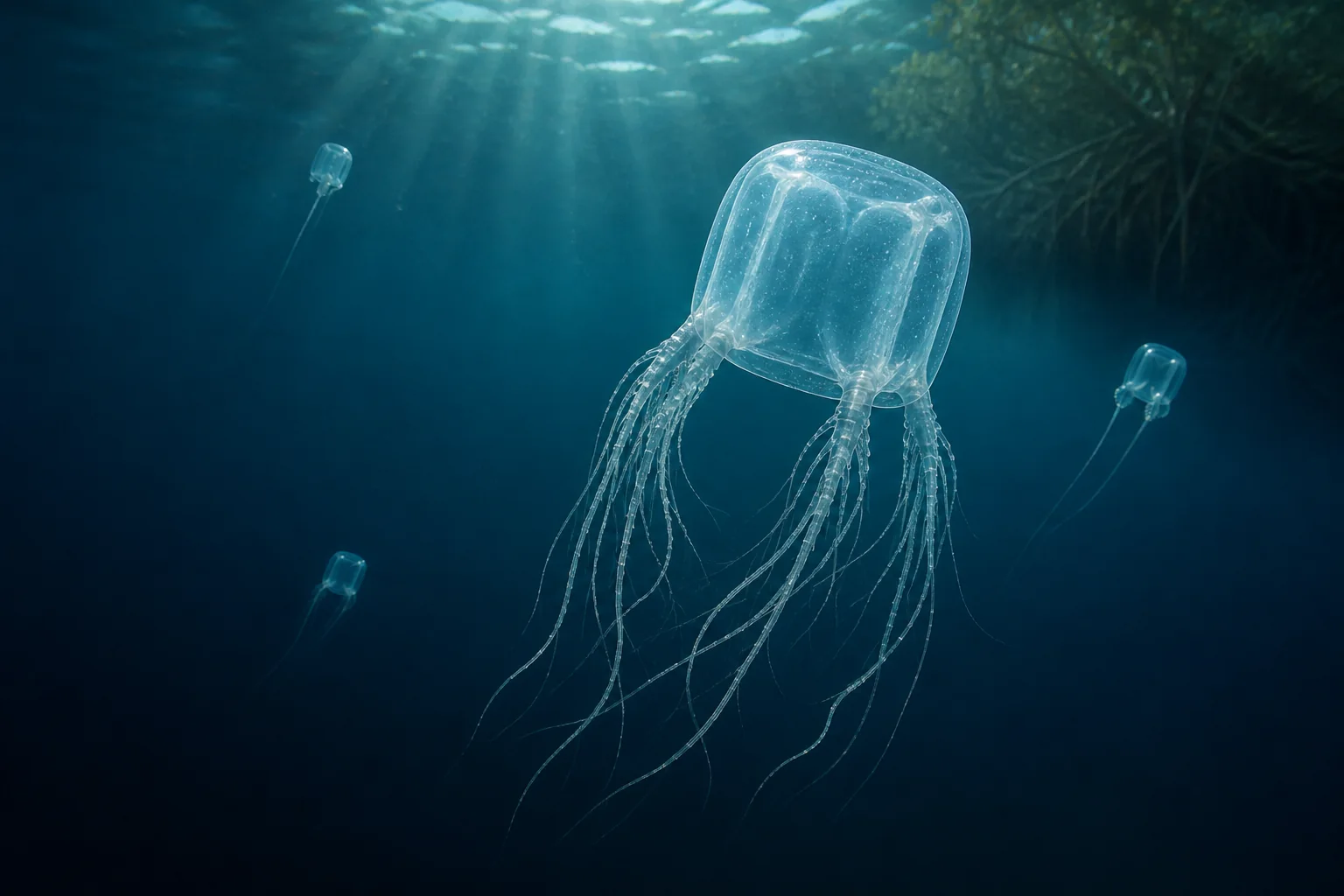
Cubozoa is the animal class containing every box jellyfish. It is not one species and it is not a family of “true jellyfish.” The class currently contains two accepted orders, eight families and 53 accepted living species in the World Register of Marine Species (WoRMS), as checked on 25 September 2026. The name comes from the four-sided bell, but classification also depends on sensory niches, tentacle-bearing pedalia, stomach structures, bell canals, museum vouchers and DNA.
Where Cubozoa sits on the tree of life
Box jellyfish are cnidarians, relatives of true jellyfish, corals, sea anemones and hydroids. Cnidarians share stinging cells called cnidocytes. Within the phylum Cnidaria, Cubozoa is a class of its own; it is not simply a family inside the “true jellyfish” class Scyphozoa.
| Kingdom | Animalia |
|---|---|
| Phylum | Cnidaria |
| Class | Cubozoa |
| Main living orders | Carybdeida and Chirodropida |
Accessible Cubozoa taxonomy tree
This tree follows accepted WoRMS names. It shows all eight families and representative genera, but not every genus or species. The nested list carries the same meaning in a screen reader and without styling.
- Class Cubozoa
- Order Carybdeida — usually one unbranched pedalium and one tentacle at each bell corner
- Alatinidae — Alatina and Manokia
- Carukiidae — Carukia, Malo, Morbakka and relatives
- Carybdeidae — Carybdea
- Tamoyidae — Tamoya
- Tripedaliidae — Copula and Tripedalia
- Order Chirodropida — the familiar members usually have branching pedalia and several tentacles per corner, but Meteorona is an important exception
- Chirodropidae — Chironex, Chirodropus and Chirodectes
- Chiropsalmidae — Chiropsalmus, Chiropsoides and Chimaerus
- Chiropsellidae — Chiropsella and Meteorona
- Order Carybdeida — usually one unbranched pedalium and one tentacle at each bell corner
Count method: we followed the WoRMS Cubozoa hierarchy from class to species and counted only records whose current status was “accepted.” Synonyms, doubtful names and records accepted outside Cubozoa were excluded. The resulting snapshot is 2 orders, 8 families, 20 genera and 53 species. Counts can change after a new description or synonymy, so the access date matters.
The two main box-jellyfish groups
Carybdeida: one tentacle per pedalium
Carybdeids generally have an unbranched pedalium at each lower corner of the bell, with one tentacle attached. The order includes tiny Irukandji-associated species, open-ocean species and mangrove specialists. It would be a mistake to give the entire order a single danger rating. Molecular analyses have usually recovered Carybdeida and Chirodropida as separate clades, but the strength and exact placement of deeper branches can vary by gene and taxon sampling (Bentlage et al., 2010).
Chirodropida: multiple tentacles per corner
Most familiar chirodropids have branching pedalia that support several tentacles. The best-known member is Chironex fleckeri. That shortcut is not a universal key: the 2015 description of Meteorona kishinouyei amended the order diagnosis because this chirodropid has an unbranched pedalium and one tentacle. Researchers therefore combine pedalial form with the rhopaliar niche, perradial lappets, velarial canals, gastric structures and molecular evidence (Toshino, Miyake & Shibata, 2015).
Family guide: useful traits, not a beach key
Family diagnoses use combinations of characters, many of which are internal, tiny or altered by growth and preservation. The table below is a starting map for reading taxonomic papers—not permission to handle an animal or force a species name from a photograph.
Carybdeida · Alatinidae
Starting point: Alatina alata has a T-shaped rhopaliar-niche opening; alatinids also require pedalial, canal and gastric-phacella characters.
Limit: a trait documented in one species is not automatically universal across the family.
Carybdeida · Carukiidae
Starting point: frown-shaped rhopaliar-niche opening with horns; gastric filaments absent in the 2010 family diagnosis.
Limit: small transparent medusae still require specialist examination.
Carybdeida · Carybdeidae
Starting point: heart-shaped rhopaliar-niche opening; the accepted family contains Carybdea.
Limit: historical “worldwide” records often hide regional species or old misidentifications.
Carybdeida · Tamoyidae
Starting point: frown-shaped rhopaliar-niche opening without the horns used in the Carukiidae diagnosis.
Limit: one bell photograph rarely exposes the decisive structures.
Carybdeida · Tripedaliidae
Starting point: the 2010 diagnosis emphasizes sexual dimorphism, spermatophores and male subgastral sacs or seminal vesicles.
Limit: these reproductive traits are not a practical field shortcut.
Chirodropida · Chirodropidae
Starting point: typically lacks lateral gonads and has pendant, separated gastric saccules with numerous branched appendages.
Limit: family definitions have changed as old material and new genera are re-examined.
Chirodropida · Chiropsalmidae
Starting point: lateral gonads plus pendant, smooth, usually unbranched finger- to cone-shaped gastric saccules.
Limit: pedalial branching and canal bends vary among its genera.
Chirodropida · Chiropsellidae
Starting point: lateral gonads plus sessile, smooth, unbranched gastric-saccule mounts; includes the one-tentacled Meteorona.
Limit: the order-level “many tentacles” shortcut fails here.
The carybdeid rhopaliar-niche and reproductive characters are summarized from Bentlage et al. (2010) and the Alatina alata redescription (Lewis et al., 2016). The three chirodropid rows follow the later family comparison and revisions by Straehler-Pohl et al. (2022). These publications themselves show why a single frozen key should not be treated as timeless.
What makes a cubozoan a cubozoan?
A roughly square bell
Seen from above, the bell has four sides or corners. The animal’s soft body flexes as it swims, so “cube” is a useful description rather than a perfect geometric rule.
Pedalia and tentacles
Each lower corner carries a muscular, paddle-like pedalium from which one or more tentacles arise. The arrangement is important in classification.
Four sensory clubs
A rhopalium sits between each pair of corners. Each structure carries multiple eyes as well as organs involved in balance and orientation. Box jellyfish can respond to visual structure without possessing a centralized brain.
A velarium for efficient swimming
A shelf of tissue narrows the bell opening and helps direct expelled water. This makes many cubozoans more purposeful swimmers than the drifting stereotype suggests.
How many species are there?
The current evidence-led answer is 53 accepted living species as of 25 September 2026. This is a dated WoRMS snapshot, not a permanent biological constant. The public taxon list also displays synonyms and uncertain names, so simply counting every line produces an inflated total. New descriptions, rediscovered type material and synonymies will change the accepted count again.
A life cycle with an unusual transformation
Most cubozoans begin as a planula larva that settles and becomes a tiny polyp. Unlike the familiar strobilation of many scyphozoan jellyfish, a cubozoan polyp generally transforms into a single juvenile medusa. Details vary among species, and much of the life cycle remains poorly documented in the wild.
Why classification keeps changing
Transparent, fragile bodies do not preserve perfectly. Two animals can look similar while DNA reveals long-separated lineages; conversely, growth or preservation can make one species appear to be several. Modern revisions therefore combine museum specimens, microscopy, molecular data and careful locality records.
That work has practical value. A precise name prevents research on a mild local species from being carelessly applied to a medically important relative—or the other way around.
Frequently asked questions
Is every square jellyfish a box jellyfish?
A four-sided bell is an important field clue, but a confident identification may require the tentacle bases, sensory structures and internal anatomy. Do not touch an animal to check.
Are box jellyfish “true jellyfish”?
They are jellyfish in ordinary language, but not members of Scyphozoa, the class often called true jellyfish. Cubozoa is a separate cnidarian class.
Does Cubozoa mean dangerous?
No. Medical importance varies enormously. A small number of species cause the gravest human stings, while others are known mainly for vision, behavior or ecology.
Classification in practice: how a box jellyfish earns a name
Modern cubozoan taxonomy is detective work at several scales. Researchers may begin with the number and branching pattern of tentacles, the shape of the muscular pedalia, stomach structures and canals near the bell margin. They then compare museum vouchers, original descriptions and DNA sequences. The strongest conclusion is integrative: independent lines of evidence point to the same boundary.
| Level | Useful question | Example of evidence |
|---|---|---|
| Class: Cubozoa | Is this a cubozoan rather than a scyphozoan medusa? | Cube-like bell, velarium, four rhopalia and pedalia |
| Order | Which combination of pedalial, bell-margin and internal characters fits? | One tentacle versus branching is useful, but Meteorona proves it is not universal |
| Family and genus | Which combination of internal and external characters fits? | Pedalial canals, gastric structures and bell-margin anatomy |
| Species | Is the difference consistent across specimens and evidence types? | Diagnostic anatomy, voucher-linked genetics, locality and comparison with type material |
Where the 2026 Singapore evidence fits
The new name follows this path: Cubozoa → Chirodropida → Chirodropidae → Chironex → Chironex blakangmati. Iesa and colleagues described it from Sentosa Island material and also documented C. indrasaksajiae in the Johor and Singapore Straits. WoRMS now lists four accepted species in Chironex: C. blakangmati, C. fleckeri, C. indrasaksajiae and C. yamaguchii.
The description shows why “looks like” is only the start. C. blakangmati resembles C. yamaguchii in its volcano-shaped pedalial canal and tentacle count, but its elongated, sharp-tipped velarial canals, absence of canal extensions from the perradial lappet terminus and DNA sequences distinguish it. The 16S and COI trees did not tell exactly the same branching story, and the authors noted more limited COI data, so the responsible conclusion is a distinct species supported by converging evidence—not a claim that every gene reconstructs an identical tree (Iesa et al., 2026).
This does not mean every unusual photograph represents a new species. New names require type material, diagnostic comparisons and publication that other specialists can challenge. It does mean that apparently familiar animals deserve well-preserved records.

Is “box jellyfish” a species?
No. It is a common name for members of the class Cubozoa. Articles that attach one size, habitat or danger level to every box jellyfish erase biologically important differences.
What remains unsettled
Species counts change with new descriptions, synonymies and database updates, so this guide records an access date rather than presenting a timeless number. Molecular trees can also differ by genes, sampling and analytical method. Where specialists disagree, the useful response is to show the competing interpretation and the evidence required to resolve it.
See the 2026 Chironex revision and the 2024 description of Copula lucentia for two recent examples of integrative cubozoan taxonomy.
Sources
- World Register of Marine Species: Cubozoa taxon list (accepted-name hierarchy checked 25 September 2026)
- Bentlage, B. et al. (2010). Evolution of box jellyfish (Cnidaria: Cubozoa). Proceedings of the Royal Society B.
- Toshino, S., Miyake, H. & Shibata, H. (2015). Meteorona kishinouyei, a new family, genus and species from Japanese waters. ZooKeys.
- Straehler-Pohl, I. et al. (2022). Ernst Haeckel’s mysterious species, Part II: African Chirodropida. Plankton and Benthos Research.
- Iesa, I., Lewis Ames, C., Yap, N. W. L. & Huang, D. (2026). Chironex box jellyfishes in Singapore. Raffles Bulletin of Zoology 74: 383–402.
Review and corrections
See an error or outdated source? Read our corrections process. Safety information is educational and does not replace local emergency services or clinical advice.