
Regional species and safety guide · Last reviewed 22 August 2026
Box jellyfish live in the western Atlantic, including parts of the Caribbean, Gulf of Mexico and Florida region. The animals and risk pattern are not identical to northern Australia. Chiropsalmus quadrumanus, Caribbean carybdeids and oceanic Alatina species are more relevant names.
Why old distribution maps mislead
Caribbean animals were once folded into broad European species names. Modern anatomy and life-cycle work separated Carybdea xaymacana from Mediterranean C. marsupialis. Precise regional records are more trustworthy than “found worldwide.”
What beachgoers should do
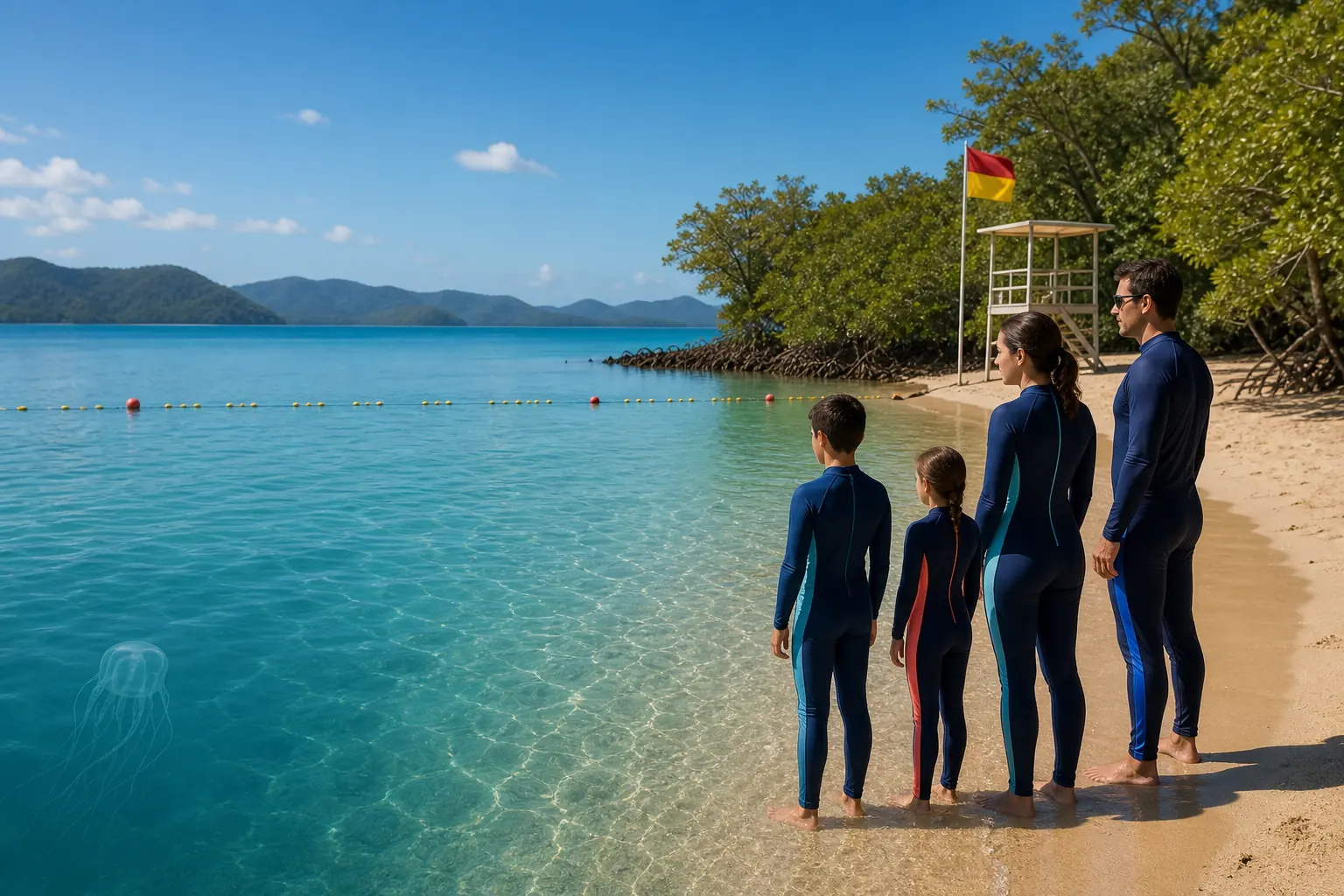
- Choose a lifeguarded beach and obey purple-flag or marine-life warnings.
- Avoid visible jellyfish, tentacles and stranded material.
- Leave the water after a sting; severe symptoms require emergency care.
- Do not assume Australian vinegar guidance applies to every local species.
- Report clusters to lifeguards or the relevant coastal authority.
Florida is not one habitat
Atlantic beaches, Florida Keys reefs, Gulf beaches and protected lagoons differ. Wind and currents can concentrate gelatinous animals locally, while a nearby beach remains clear. Consult the county or park responsible for the exact site.
Florida, the Gulf and the Caribbean are not one risk zone
The western Atlantic includes open Atlantic beaches, sheltered Florida Keys water, Gulf beaches, mangrove lagoons and many island jurisdictions. Species records, wind exposure, patrol systems and emergency advice differ among them. A report from Puerto Rico should not be treated as a forecast for Miami or the Florida Panhandle.
Box jellyfish reported in the region
| Group | Useful identification context | Caution |
|---|---|---|
| Chiropsalmus quadrumanus | Multi-tentacled western Atlantic cubozoan | Can be medically significant; confirmation requires more than the common name “sea wasp” |
| Carybdea xaymacana | Single tentacle at each corner; western Atlantic records | Older sources may incorrectly use the Mediterranean name C. marsupialis |
| Alatina species | Slender oceanic cubozoans with near-shore aggregations in some places | Timing documented at one locality is not a regional calendar |
Before entering the water
- Use the county, park, resort or lifeguard responsible for the exact beach.
- Obey marine-life flags and closures.
- Ask whether recent reports were confirmed and what animal was involved.
- Keep away from stranded bells, floats and detached tentacles.
- Know that surf, lightning and currents may be the more immediate hazard.
After a sting
Call 911 for collapse, breathing difficulty, severe whole-body symptoms or rapidly worsening pain. Do not import vinegar or hot-water advice from another species and country. Follow the lifeguard, emergency dispatcher or poison-control guidance for the location.
Frequently asked questions
Does Florida have the Australian box jellyfish?
Western Atlantic cubozoans occur in Florida waters, but a regional “box jellyfish” report does not establish Chironex fleckeri. Use current taxonomic records.
Is there one Florida box-jellyfish season?
No statewide calendar reliably predicts every coast and species. Current local monitoring is more useful than a generic month range.
Sources
- NOAA National Ocean Service: box jellyfish
- World Register of Marine Species
- NOAA repository: Alatina migrations
Independent clinical review is pending. Local emergency guidance takes precedence.
Review and corrections
See an error or outdated source? Read our corrections process. Safety information is educational and does not replace local emergency services or clinical advice.