
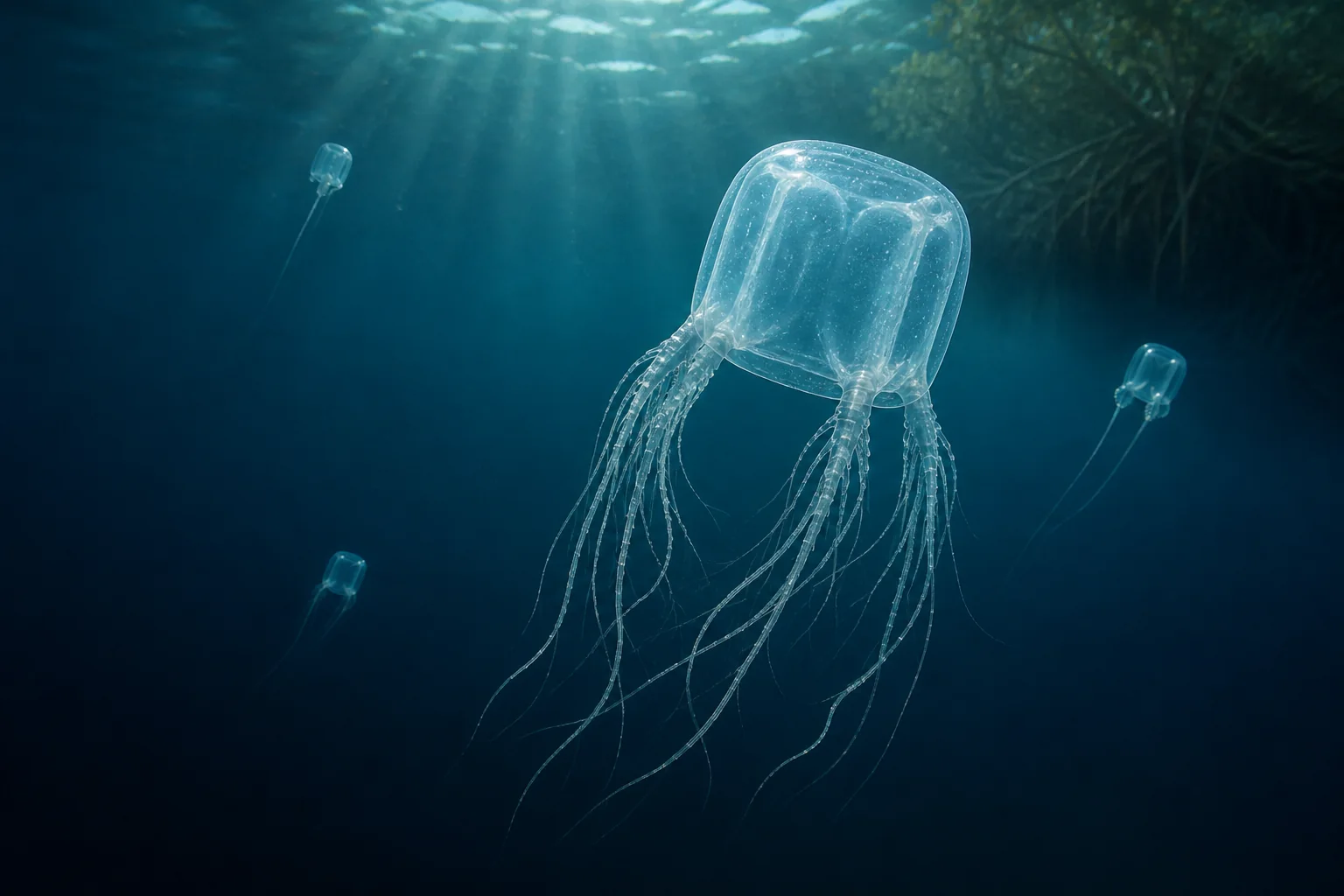
Species profile · Last reviewed 22 August 2026
Tripedalia cystophora is a small mangrove box jellyfish that became famous for what it can see. Its visual system helps it remain in a narrow, sunlit habitat and navigate around obstacles—without a centralized brain.
A mangrove specialist
This species is associated with sheltered tropical mangrove lagoons, where shafts of light, roots and canopy edges create a visually complex world. It hunts tiny crustacean prey and must avoid being swept away from productive water.
Twenty-four eyes, four sensory clubs
Each of the four rhopalia carries six eyes of different types, for 24 in total. Some form images; others detect simpler light cues. The rhopalium also helps with orientation. Neural processing is distributed through the animal rather than organized into a vertebrate-like brain.
How it steers
The jellyfish changes the direction of its swimming jets by flexing tissue around the bell opening. Vision feeds into rapid course corrections, allowing purposeful movement among mangrove roots. Calling that behavior “intelligent” can be tempting, but it is more precise to describe the sensory task and measured response.
Human-risk context
T. cystophora is not discussed in the same medical category as large lethal Chironex species. That does not make handling sensible: all cubozoans possess stinging cells, individual reactions vary, and field identification can be wrong.
Why it matters beyond jellyfish
The species gives neuroscientists a compact system for asking how visual information guides behavior without a large central brain. It also reminds us that an animal can be anatomically simple in one respect and highly specialized in another.
Species snapshot
| Accepted name | Tripedalia cystophora |
|---|---|
| Order | Carybdeida |
| Habitat | Sheltered tropical mangrove lagoons |
| Eyes | Six per rhopalium, 24 in the common cubozoan arrangement |
| Research importance | Visual navigation without a centralized brain |
Why mangrove habitat is visually demanding
Roots, canopy gaps, shafts of light and water boundaries create strong patterns. The jellyfish must remain near prey-rich water without colliding with structure or drifting out of the lagoon. Experiments show that broad visual features can guide steering even though the animal has low-resolution eyes.
A divided visual workload
The two lens eyes on each rhopalium form images, while slit and pit eyes detect simpler light cues. A statolith weights the rhopalium and helps maintain orientation. The system does not produce human-like vision; it extracts the limited information needed for habitat and movement.
Swimming and feeding
Muscles contract the bell and a velarium directs the jet. Visual input can produce rapid course corrections around dark obstacles. The species feeds on small crustaceans, linking its sensory specialization to a narrow mangrove food web.
Life-history questions
Like other cubozoans, the life cycle includes a planula, attached polyp and swimming medusa. The exact timing and survival of stages in natural mangrove systems deserve more field study. Laboratory success does not automatically describe wild population dynamics.
Why it matters to neuroscience
T. cystophora lets researchers examine how small distributed neural circuits turn visual input into behavior. It is a useful counterexample to the assumption that complex eyes require a large centralized brain.
Human-risk context
The species is not grouped with lethal Chironex in public-health guidance. It should still not be handled: all cubozoans have stinging cells, individual reactions vary and field identification can be wrong.
Sources
Review and corrections
See an error or outdated source? Read our corrections process. Safety information is educational and does not replace local emergency services or clinical advice.