
Biomechanics · Last reviewed 9 October 2026
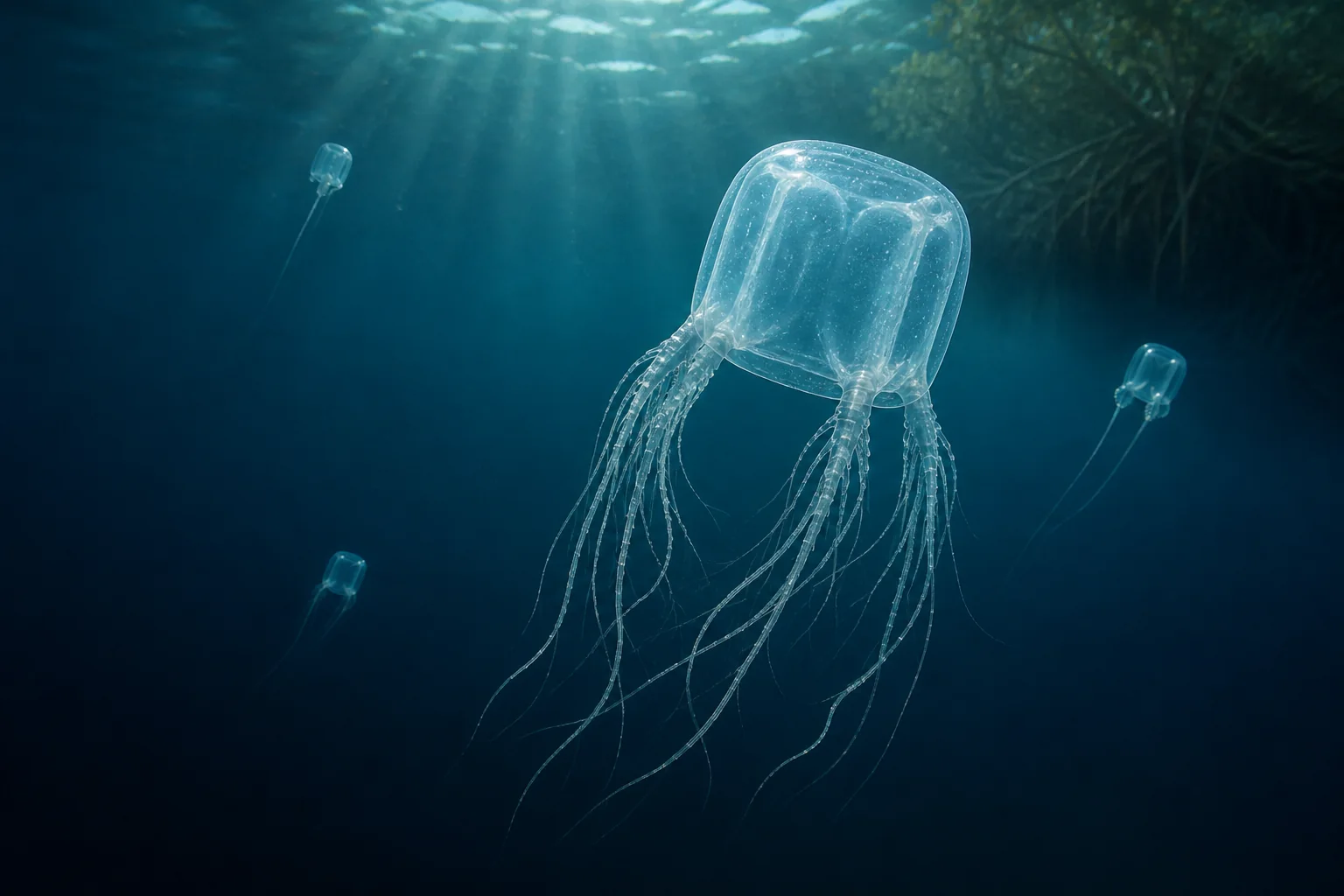
Box jellyfish swim by contracting their bell and pushing water through a muscular opening called the velarium. They steer by changing the shape and position of that opening and by contracting different parts of the bell at slightly different times. Published measurements vary by species, body size, behavior and method; a field study recorded a brief maximum of 16.6 cm/s (0.60 km/h) for Chironex fleckeri, far below the unsourced “four knots” repeated online.
The swimming cycle: squeeze, jet, refill
The inside of a box jellyfish bell is lined with circular muscle. When that muscle contracts, the bell cavity becomes smaller and water is expelled through the opening underneath. The animal moves in the opposite direction. The bell then relaxes and refills before the next pulse.
The velarium is a flexible, muscular shelf around the bell opening. Four muscular supports called frenula connect it to the inside of the bell. By narrowing the outlet, the velarium behaves like an adjustable nozzle: it changes the speed and direction of the outflow rather than generating thrust by itself. In a 2024 particle-image-velocimetry study of Carybdea brevipedalia, the suction-and-discharge cycle lasted about 0.5 seconds under the laboratory conditions, while speed rose and fell within each cycle.[1]

Why the simple “jet engine” description is incomplete
Small cubozoans can produce a narrow jet, but larger animals do not merely scale up the same motion. Flow-visualization experiments on Chironex fleckeri and Chiropsella bronzie found that juveniles used a more jet-like mode, while larger medusae shifted toward a rowing–jetting hybrid. Their more flexible velarium and changing bell motion produced different vortex patterns as they grew.[2] So “box jellyfish use jet propulsion” is a useful first answer, not a complete description of every size and species.
How fast can a box jellyfish swim?
There is no defensible speed limit for the whole class Cubozoa. The strongest comparable evidence is measured for named species and sizes. Even then, “maximum,” “mean” and “effective velocity” answer different questions.
| Species and size | Reported result | Method and meaning |
|---|---|---|
| Chironex fleckeri, 4–12 cm interpedalial distance | Maximum observed: 16.6 cm/s (0.60 km/h) | Short field tracks in a shallow Australian bay; a burst maximum, not a sustained cruising speed.[3] |
| C. fleckeri, about 10 cm bell diameter | Maximum reported: 11.5 cm/s | Digital-video analysis in a large outdoor tank.[4] |
| Chiropsalmus sp., about 4.5 cm bell diameter | Maximum reported: 6.7 cm/s | Digital-video analysis in an aquarium.[4] |
| Carybdea marsupialis, 1.1–36 mm diagonal bell width | Mean speed by stage: 0.97, 2.19 and 4.31 cm/s; average maxima: 1.86, 4.10 and 7.54 cm/s | Video tracks of small juveniles, medium juveniles and adults in still laboratory water; larger animals were faster in absolute terms.[5] |
| Tripedalia cystophora, about 8–12 mm bell diameter | Maximum: 3–4 cm/s against a 1–1.5 cm/s current | Flow-chamber obstacle-avoidance trials; small animal, controlled current.[6] |
Speed check: the 16.6 cm/s field maximum equals about 0.32 knots, not four knots. Popular figures near four knots (roughly 2 m/s) are more than ten times the fastest C. fleckeri value in the primary studies reviewed here. That does not prove no cubozoan could ever exceed 16.6 cm/s; it means a much larger number should not be presented as established without a traceable species, specimen, method and dataset.
Why published speed numbers do not line up neatly
- Distance is not displacement
- A jellyfish can travel quickly along a curved path but make little progress in one direction. The 2024 Carybdea marsupialis study measured both path speed and effective velocity, then calculated an effective displacement index. Adults followed straighter tracks than small juveniles in that tank.[5]
- Still water is not the sea
- Tank video is useful for body mechanics but removes waves, turbulence and many visual cues. Field movement combines active swimming with water motion unless the current is measured and subtracted.
- Maximum is not cruising speed
- A brief peak from a short track cannot be converted into “distance per hour” as if the animal maintained it continuously. The C. fleckeri field study used 5.3 cm/s as an average-swimming parameter in its population model, substantially below its 16.6 cm/s maximum.[3]
- Body measurement matters
- Researchers report bell diameter, diagonal bell width or interpedalial distance. Those measurements are not interchangeable, and two species with the same width can have different bell shapes and swimming kinematics.
- Size changes the answer
- Larger individuals often travel faster in absolute units, while smaller individuals may cover more body lengths per second. The relationship can also differ between a controlled tank and voluntary behavior in the wild.[4][5]
How a box jellyfish turns without fins
A turn starts by making the outflow asymmetric. In tethered Tripedalia cystophora, darkening one part of the visual scene shifted the velarial opening off center and delayed the contraction on the side facing the dark sector. The combined asymmetry would steer a free-swimming animal away from that sector.[7] A later experiment found three recurring velarial-opening shapes under different light patterns, strengthening the connection between visual input, nozzle shape and directional swimming.[8]
Flow visualization in larger cubozoans adds another layer: turning can involve asymmetric vortex structures during both contraction and expansion, not only a single sideways jet.[2] The exact maneuver therefore depends on species, size and swimming phase.
How the eyes and four pacemakers coordinate a pulse
Each of the four rhopalia contains eyes and a swim pacemaker. Signals pass through the ring nerve and nerve net to the bell muscles. In T. cystophora, reducing the animal from four rhopalia to one lowered its mean and median pulse frequency under experimental conditions; a sudden light decrease raised pulse frequency in both groups.[9]
That does not mean one rhopalium is a “brain” or that all four simply fire together. Models suggest inhibitory coupling may let a more active pacemaker influence the shared rhythm, but the authors could not reproduce every long pause seen in intact animals. The honest conclusion is distributed coordination with important details still unresolved, not four independent engines.
Can box jellyfish swim against a current?
Sometimes, at the scale of the current and animal tested. Adult Carybdea marsupialis in one Mediterranean study were theoretically fast enough to exceed nearly 70% of the local surface-current measurements used for comparison, while the smallest juveniles exceeded fewer than 17%. The authors treated this as a theoretical comparison rather than proof of where every animal would go in nature.[5]
A biophysical model for C. fleckeri in Port Musgrave, Australia, likewise found that measured swimming behavior could help retain animals near shore under some conditions, but flood-driven transport still reduced retention.[3] Active swimming matters; tides, river flow, wind and habitat geometry still matter too.
What swimming ability does—and does not—tell us
- It helps explain habitat use. Directed motion can keep an animal near prey, mangrove structure or coastal habitat rather than leaving every movement to drift.
- It supports visually guided behavior. T. cystophora can alter pulse rate and direction in response to light structure and obstacles.
- It does not show that box jellyfish chase people. The cited experiments test propulsion, orientation and obstacle responses, not human targeting.
- It does not make one speed universal. Cubozoa contains many species, life stages and body forms. A value from one setup should not be pasted onto all of them.
Frequently asked questions
Are box jellyfish faster than humans?
Not according to the traceable cubozoan measurements summarized here. The fastest cited C. fleckeri burst was 0.60 km/h. Comparing that short burst with a human race is still imperfect because the animals, distances and measurement methods differ.
Do box jellyfish only drift?
No. They pulse, steer and can make directed movements. Currents still transport them, especially when the current exceeds their swimming ability or during less mobile life stages.
Does every box jellyfish use the same stroke?
No. Species, body size and bell flexibility matter. Research on two Australian species found a shift from a more jet-like mode in smaller animals toward a rowing–jetting hybrid in larger ones.
What part is the velarium?
It is the muscular shelf around the opening under the bell. See the larger labeled box jellyfish anatomy diagram for its position relative to the bell, rhopalia, pedalia and tentacles.
Continue exploring
Follow the control pathway through the rhopalia, see how box jellyfish eyes guide behavior, meet the mangrove specialist Tripedalia cystophora, or compare the currents and habitats where cubozoans occur.
Sources and methods
This article prioritizes measurements from primary studies. Speed values are reported with the species, size class and method because those details change the interpretation.
- Pyeon Y, Chae J, Oh W, Hwang DJ, Lee K (2024). Swimming behavior analysis of small box jellyfish (Carybdea brevipedalia). Fisheries and Aquatic Sciences 27:1–6.
- Colin SP, Costello JH, Katija K, Seymour J, Kiefer K (2013). Propulsion in Cubomedusae: Mechanisms and Utility. PLoS ONE 8:e56393.
- Schlaefer JA, Wolanski E, Kingsford MJ (2018). Swimming behaviour can maintain localised jellyfish (Chironex fleckeri) populations. Marine Ecology Progress Series 591:287–302.
- Shorten M et al. (2005). Kinematic analysis of swimming in Australian box jellyfish. Journal of Zoology 267:371–380.
- Bordehore C, Manchado-Pérez S, Fonfría ES (2024). Swimming ability of Carybdea marsupialis: implications for its spatial distribution. Journal of Zoology 324:1–10. Supporting data: Zenodo.
- Garm A et al. (2007). Visually guided obstacle avoidance in the box jellyfish Tripedalia cystophora and Chiropsella bronzie. Journal of Experimental Biology 210:3616–3623.
- Petie R, Garm A, Nilsson DE (2011). Visual control of steering in the box jellyfish Tripedalia cystophora. Journal of Experimental Biology 214:2809–2815.
- Petie R, Garm A, Nilsson DE (2013). Velarium control and visual steering in box jellyfish. Journal of Comparative Physiology A 199:315–324.
- Stöckl AL, Petie R, Nilsson DE (2011). Setting the Pace: New Insights into Central Pattern Generator Interactions in Box Jellyfish Swimming. PLoS ONE 6:e27201.
Review and corrections
See an error or outdated source? Read our corrections process. Safety information is educational and does not replace local emergency services or clinical advice.