
Habitat FAQ · Last reviewed 22 August 2026
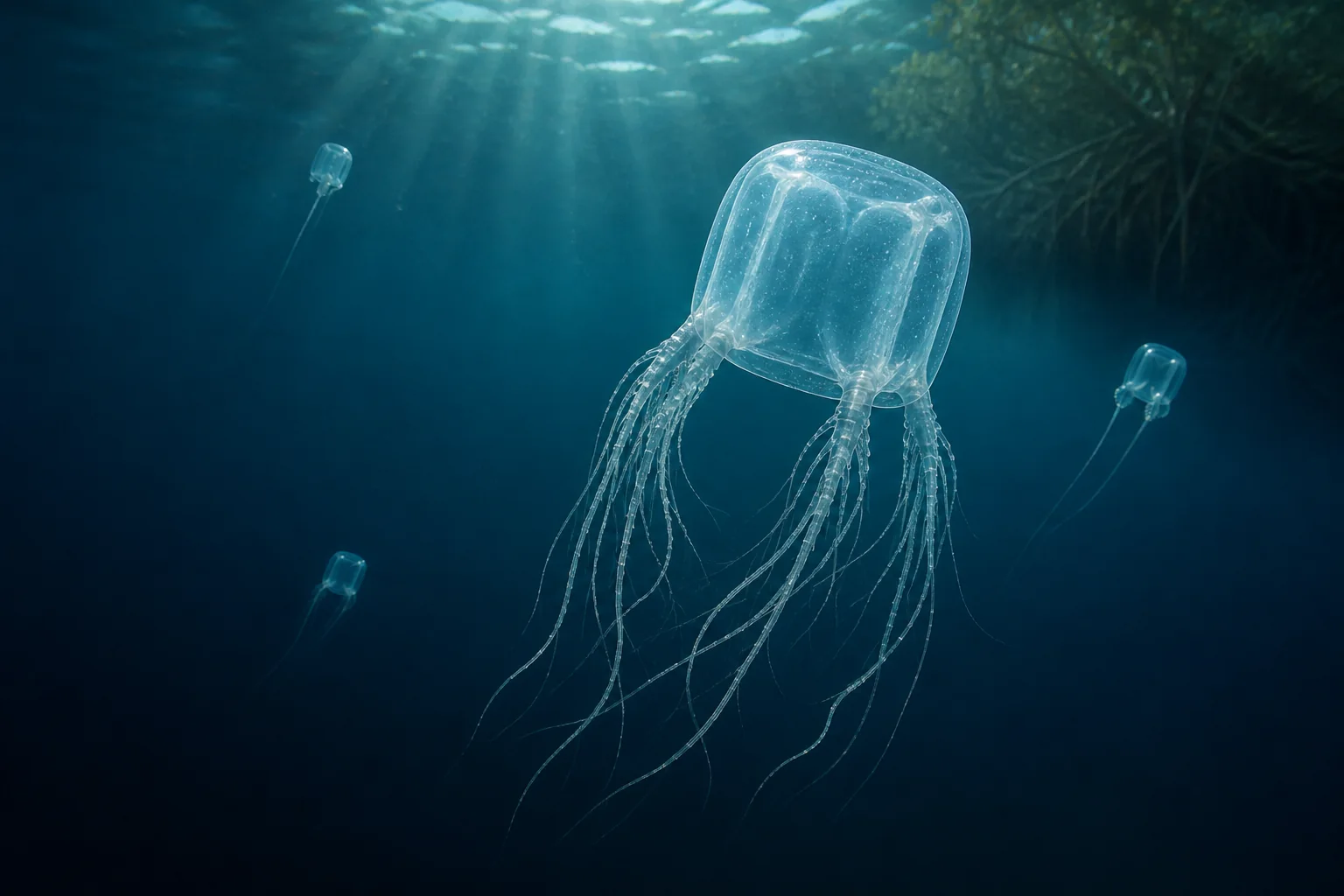
Box jellyfish are marine animals. Some species enter estuaries, tidal creeks and river mouths where salinity changes with rain and tide, but they are not residents of ordinary freshwater lakes and inland rivers.
Estuarine is not freshwater
An estuary mixes seawater and river water. Its salinity can range widely over a day or season while still remaining connected to the sea. Reports of box jellyfish “in a river” usually refer to the tidal, brackish reach.
Why are they near river mouths?
Sheltered shallow water can offer prey and suitable life-cycle habitat. Northern Australian authorities note more Chironex around creek and river outlets under some calm, rainy conditions. This is a regional risk observation, not proof that fresh water attracts every species.
What happens in tap water?
Abrupt low salinity stresses marine tissues and can trigger unfired nematocysts. That is why current sting guidance warns against fresh-water rinsing of remaining marine tentacles. It does not mean pouring fresh water kills or neutralizes the hazard safely.
Could one evolve in fresh water?
Evolution makes many outcomes possible over long timescales, but no accepted cubozoan is established as a landlocked freshwater jellyfish. Some unrelated hydrozoan jellyfish do live in fresh water and are often confused with “tiny box jellyfish.”
Salinity explains the confusion
Fresh water contains very little dissolved salt. Seawater is much saltier, while brackish water lies between and can change rapidly with rain and tide. A jellyfish recorded several kilometres up a tidal river may still be in water influenced by the sea.
| Water body | Connection to sea | Box-jellyfish interpretation |
|---|---|---|
| Estuary or tidal creek | Direct and changing | Some marine species may enter or tolerate brackish reaches |
| River above the tidal limit | No routine seawater mixing | No accepted cubozoan population is established |
| Landlocked lake or reservoir | None | Small hydrozoan freshwater jellyfish may be misidentified as “box jellyfish” |
| Aquarium or laboratory water | Artificially controlled | Survival does not establish a wild freshwater species |
Why estuaries can suit some life stages
Shelter, prey, warm shallow water and hard surfaces for tiny polyps can make creek and mangrove systems important. Salinity is only one part of habitat. Oxygen, temperature, turbidity and rapid freshwater runoff may also constrain the animal.
Freshwater jellyfish are different animals
The small jellyfish sometimes reported from ponds and reservoirs are generally hydrozoans, not members of Cubozoa. A cube-like body, pedalia and cubozoan rhopalia are not features of the common freshwater forms. A photograph and location help prevent the common-name confusion.
What rain means for swimmers
Heavy rain can change salinity and discharge around river mouths, but it does not make a tidal beach “freshwater safe.” Northern Australian authorities sometimes associate encounters with local rain and calm conditions near outlets. That regional observation should not become a universal weather rule.
Frequently asked questions
Can tap water safely kill tentacles?
No. Sudden low salinity can stimulate unfired nematocysts in some marine jellyfish. Follow the current local sting protocol and do not rinse remaining marine tentacles with fresh water.
Could a cubozoan evolve into fresh water someday?
Evolutionary change is possible over long timescales, but no accepted landlocked freshwater cubozoan is presently established. A hypothetical future is not evidence of a current species.
Sources
Review and corrections
See an error or outdated source? Read our corrections process. Safety information is educational and does not replace local emergency services or clinical advice.