
Adaptation explained · Last reviewed 20 October 2026
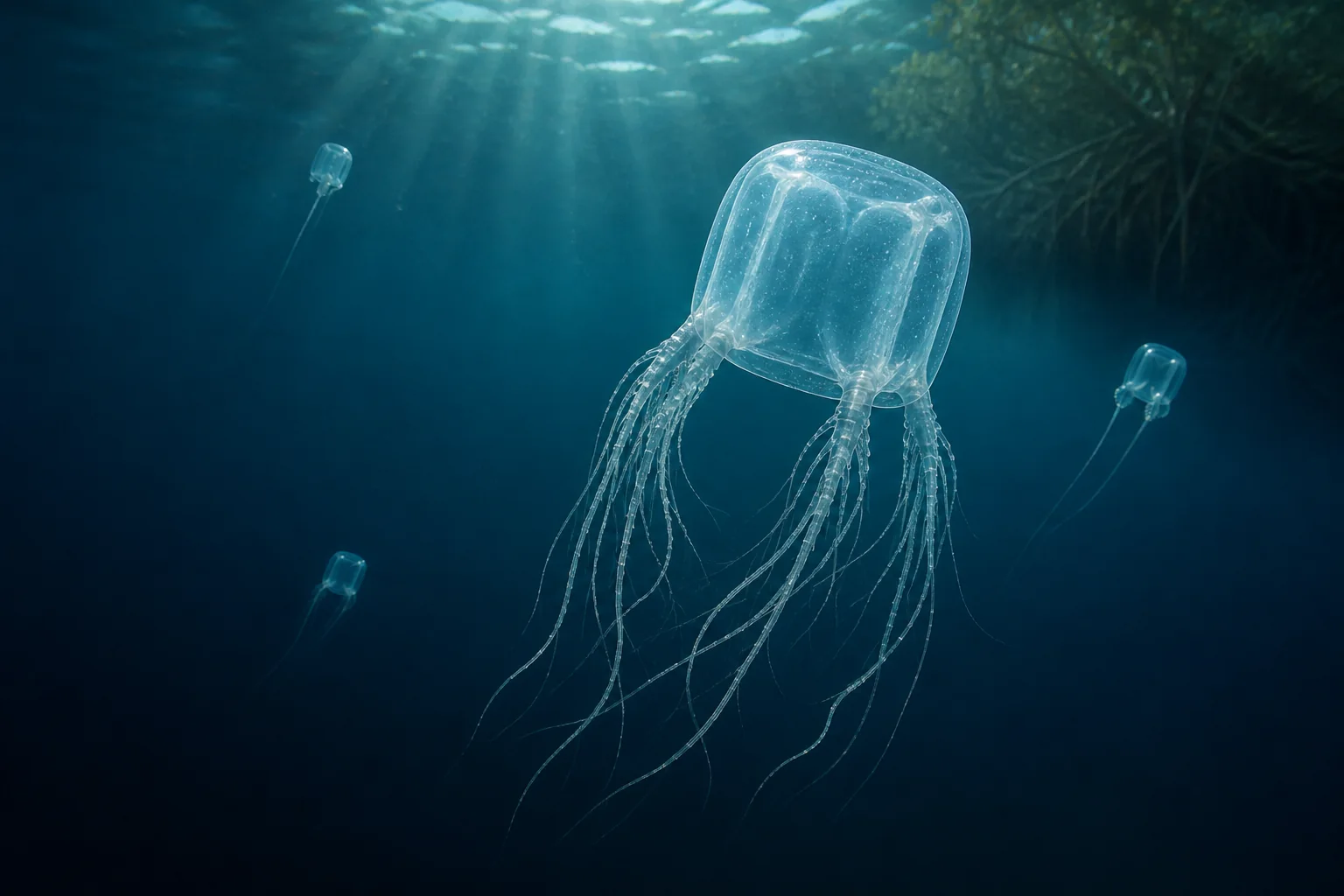
Box jellyfish look transparent because their bells are built largely from water-rich mesoglea enclosed by thin living tissue, with relatively little pigment or other material to absorb and scatter visible light. The tissue’s optical properties are close enough to seawater that much of the background light passes through instead of producing a strong outline. This can reduce visual contrast, but it never makes the animal perfectly invisible.
To look clear, tissue has to solve three optical problems
“Transparent” is not simply another word for colorless. A colorless object may still appear white if it scatters light, as foam does. Biological tissue becomes hard to see only when it keeps three sources of contrast low:
- Absorption: pigments and other molecules remove certain wavelengths, making tissue look darker or colored.
- Scattering: cells, fibres, membranes and particles redirect light, revealing the body as a haze or bright edge.
- Reflection: light bounces from a boundary when the refractive indices on its two sides differ.
Optical models of transparent tissues show that scattering falls when structures are sparse, small relative to the relevant wavelengths, arranged regularly or surrounded by material with a similar refractive index.1 A jellyfish cannot remove every cell or fibre, so transparency is always a compromise with muscle, nerves, digestion, reproduction and repair.
Mesoglea makes a large bell with little optical contrast
The bell is not a bag of plain seawater. Its thick middle layer, the mesoglea, is an extracellular matrix containing water, collagenous material and cells whose amount and organization vary among medusae. Because much of that volume is hydrated material rather than densely packed tissue, it can create less absorption and scattering than an equally large, muscle-filled body.
Refractive-index matching is a major part of the effect. Research on jellyfish surfaces notes that the index difference between gelatinous umbrella tissue and seawater can be extremely small—about 0.001 in the system modeled—so even a flat tissue–water boundary reflects very little light.2 That value should not be treated as a universal measurement for every box jellyfish species, temperature or salinity; it demonstrates why water-rich tissue can have a weak optical boundary.
The same watery structure has a mechanical job. The bell deforms during a swimming pulse, and elastic tissues help it recover shape. Transparency may therefore be both useful camouflage and a consequence of constructing a voluminous swimming body from hydrated material. Evolution need not choose only one explanation. See how the bell and velarium produce thrust.
Does the bell have an anti-reflective surface?
A microscopy study comparing six jellyfish included the cubozoan Chironex yamaguchii. Its outer bell surface carried dense microvilli, and optical simulations suggested that such arrays could reduce surface reflection under modeled conditions.3 Later modeling emphasized an important limit: underwater, the tissue–seawater index difference is already so small that the extra anti-reflective benefit of microvilli may be modest.2
So the safest conclusion is not “box jellyfish have a perfect invisibility coating.” The better-supported claim is that a close optical match with seawater produces low reflection, while surface nanostructures may fine-tune that boundary and may also serve non-optical functions.
Transparency works by passing the background through
Color camouflage matches one surface to one background. Transparency takes a different route: background light travels through the animal, so its apparent brightness can adjust automatically when the open-water background changes. That is particularly useful in midwater, where there may be no rock, plant or patch of sand to copy.4

| Viewing condition | Likely source of contrast | What can be said confidently |
|---|---|---|
| Even open water | Low absorption and weak surface reflection can leave only a faint outline. | Transparency is generally effective against a broad, unstructured light field; “invisible” is still too strong. |
| Viewed from below | The animal may interrupt downwelling light or scatter light toward the observer. | Models for gelatinous zooplankton show that detection depends on contrast threshold, light level and depth.5 |
| Side light or a diver’s lamp | Bell edges, muscle fibres and tentacles can scatter the directional light. | Field imaging of transparent zooplankton found scattering of downwelling light to be a major visual signal.6 |
| Turbid or particle-rich water | Particles add veiling light and can cling to tentacles; illumination becomes uneven. | Visibility may rise or fall with distance and lighting. “Murky water always hides them” is not defensible. |
| Near seafloor, roots or vegetation | A patterned background can reveal edges and opaque organs. | Transparency is principally a pelagic solution and is less reliable against nearby visual texture.4 |
Depth changes the observer as well as the animal
In a 1998 study, researchers measured visible-light transmission from 400 to 700 nanometres in 29 living gelatinous zooplankton species. Transparency varied widely—from 91% in one hydromedusa to less than 1% in a pteropod—and generally increased toward longer wavelengths. Modeling showed that partial transparency became more useful as light levels fell because a viewer’s minimum detectable contrast increased.5
Those numbers are often repeated as though they describe every jellyfish. They do not. The study demonstrates variation and a depth-dependent visibility principle; it does not provide a transmission percentage for Chironex fleckeri, Tripedalia cystophora or all Cubozoa.
Why the whole box jellyfish never disappears
Some structures must absorb or redirect light to work. The labeled anatomy guide shows where these parts sit in the bell; the most noticeable can include:
- Rhopalia and eyes: photopigments must absorb photons, and lenses bend light. Explore the rhopalia and their sensory functions.
- Muscle and connective fibres: aligned fibres can scatter light and create bright lines under directional illumination.
- Stomach contents and canals: prey, digested material and thicker gastrovascular tissues may contrast with the bell.
- Gonads: reproductive tissue can be more opaque or colored, and its visibility can change with maturity.
- Tentacles and nematocyst-bearing tissue: these fine structures can catch side light, collect particles or stand out against a darker background.
Even a box jellyfish can look through its own bell: steering experiments with Tripedalia cystophora exploited that transparency while testing visual responses through the animal’s tissues.7 But “light can pass through” does not mean every wavelength, angle and body part is equally clear.
Can predators defeat transparent camouflage?
Yes. Transparent prey can still be found through edge contrast, motion, scattered light and specialized visual channels. In situ imaging of gelatinous zooplankton found that birefringence was not the dominant signal researchers expected; unpolarized downwelling light scattered by the animals often produced the stronger contrast against a darker, polarized horizontal background.6 This is a useful reminder that a transparent animal can become conspicuous when illumination and viewing direction align.
Ultraviolet light creates another trade-off. Measurements across transparent epipelagic and mesopelagic zooplankton found wavelength-dependent UV absorption. UV-protective compounds can protect tissue but also reduce transparency to observers that see ultraviolet.8 No equivalent whole-animal UV curve should be assumed for box jellyfish without species-specific measurements.
What is directly known for box jellyfish?
| Claim | Evidence status | Reason |
|---|---|---|
| Many box jellyfish have transparent or translucent bells | Well observed | Specimens, photographs and anatomical work consistently show light-transmitting bells, although species and life stages vary. |
| Chironex yamaguchii has dense bell-surface microvilli | Direct microscopy | The 2021 comparative surface study included this named cubozoan.3 |
| Microvilli make box jellyfish invisible | Not established | Reflectance effects were modeled, and later work says the extra underwater benefit may be limited because index matching already keeps reflection low.2 |
| A specific box jellyfish is “X% transparent” | Unknown from the studies reviewed | No calibrated whole-animal visible-spectrum curve for a named cubozoan was found in the primary literature used for this update. |
| Transparency evolved only as camouflage | Too simple | Camouflage is supported broadly, but hydrated tissue also contributes to body construction and swimming mechanics. |
The measurements still needed
- Whole-animal spectral transmission curves for named box jellyfish, measured alive in seawater.
- Field sighting distances from multiple angles, depths, water clarities and backgrounds.
- Separate measurements for bell, velarium, pedalia, tentacles, gonads and feeding state.
- Tests of how age, salinity, injury and tissue condition change scattering.
- Visual models based on actual predators and prey rather than human eyesight alone.
Until those data exist, photographs cannot supply a universal visibility score. Camera exposure, flash direction, background and post-processing can make the same animal look almost absent or sharply outlined. For practical appearance cues, use the box jellyfish identification guide; transparency alone cannot identify a species or predict sting risk.
Quick questions
Are box jellyfish completely invisible?
No. Their bells may transmit much of the background light, but edges, eyes, muscles, gonads, stomach contents and tentacles can remain visible. Lighting and background can change contrast dramatically.
Are all box jellyfish colorless?
No. Transparency varies among species, life stages and body parts. Some internal tissues or tentacles may be pale blue, brownish, pinkish or otherwise colored.
Does clear water make them harder to see?
Not always. Clear water can preserve the background match over distance, but bright side light or a patterned seafloor may reveal the outline. Turbidity can also obscure or illuminate an animal depending on direction and distance.
Does transparency mean a box jellyfish is dangerous?
No. Transparency is an optical trait, not a measure of venom potency. Never use clarity, size or color alone to judge whether contact is safe.
Primary sources and research synthesis
- Johnsen (1999). The physical basis of transparency in biological tissue: ultrastructure and the minimization of light scattering.
- Hirose et al. (2025). Optical properties of the jellyfish surface above the waterline.
- Sakai et al. (2021). Exumbrellar surface of jellyfish: a comparative fine structure study with remarks on surface reflectance.
- Johnsen (2001). Hidden in plain sight: the ecology and physiology of organismal transparency.
- Johnsen & Widder (1998). Transparency and visibility of gelatinous zooplankton from the Northwestern Atlantic and Gulf of Mexico.
- Johnsen, Marshall & Widder (2011). Polarization sensitivity as a contrast enhancer in pelagic predators.
- Petie, Garm & Nilsson (2013). Velarium control and visual steering in box jellyfish.
- Johnsen & Widder (2001). Ultraviolet absorption in transparent zooplankton and its implications for depth distribution and visual predation.
Review and corrections
See an error or outdated source? Read our corrections process. Safety information is educational and does not replace local emergency services or clinical advice.