
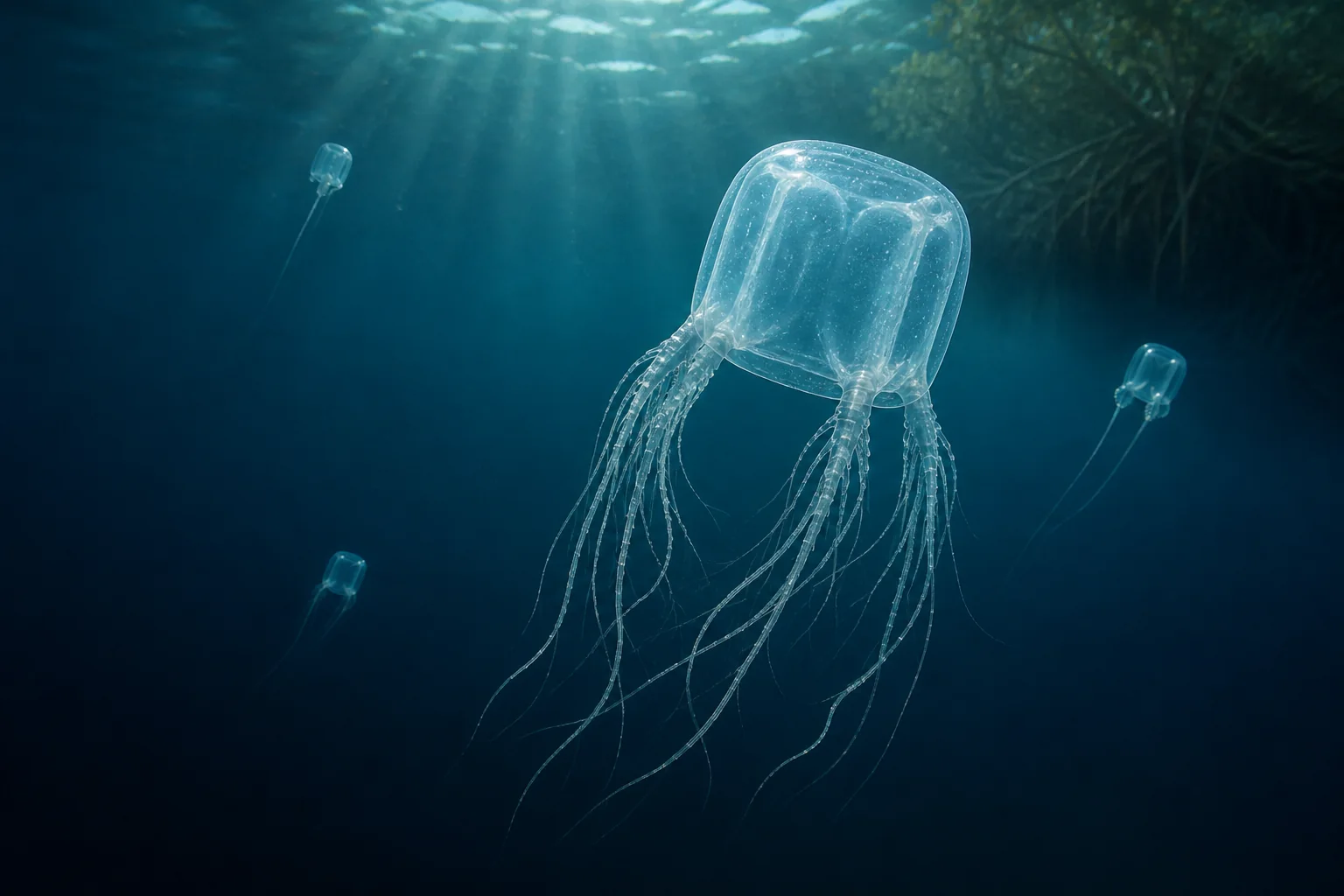
Anatomy close-up · Last reviewed 13 October 2026
Box jellyfish rhopalia are four small sensory clubs spaced around the bell margin. In well-studied species, each rhopalium carries six eyes, a gravity-sensitive statolith and a local neural network that includes a swim pacemaker. That arrangement puts sensing and part of the response pathway in the same compact structure—but a rhopalium is not a miniature brain.

A rhopalium is more than an eye holder
From the outside, a rhopalium looks like a tiny club suspended in a niche at the lower bell margin. Inside is a surprisingly organized system. Microscopy and electrophysiology in Tripedalia cystophora show that the rhopalial stalk connects directly with the bell’s ring nerve, while neural processing is distributed through the rhopalium, stalk and wider nerve system.1 Anatomical work in T. cystophora and Carybdea marsupialis also found prominent RFamide-immunoreactive neuron groups, but staining a neuron population does not by itself prove every function proposed for it.2
| Part | What is established | Important limit |
|---|---|---|
| Upper lens eye | One image-forming eye; in T. cystophora it looks upward through the water surface and supports mangrove-edge navigation.3 | This specialized task should not be assigned to every box jellyfish habitat. |
| Lower lens eye | One image-forming eye oriented into the underwater scene; lens-eye input can alter pacemaker firing in isolated T. cystophora rhopalia.4 | A camera-type eye does not imply human-like detail or perception. |
| Paired pit eyes | Two pigment-cup eyes without lenses. Experiments indicate that their light responses can affect pacemaker activity.4 | Their complete behavioral roles remain unresolved. |
| Paired slit eyes | Two elongated pigment-cup eyes with broad visual fields.5 | Structure and optics are better established than a single exclusive behavior. |
| Statolith | A dense crystal acts as a weight, helping keep the hanging rhopalium upright as the bell tilts.6 | It is a mechanical orientation system, not an ear. |
| Neural tissue and pacemaker | Local circuits receive sensory input and generate signals associated one-for-one with swim contractions.4 | The four rhopalia interact; one structure does not command the animal alone. |
From light to movement: the shortest useful model
A visual change can alter activity in the rhopalial nervous system, which in turn can change pacemaker timing. Pacemaker signals travel through the nerve system to the swimming musculature; asymmetric velarium movements can redirect the jet and steer the animal. The diagram below is a synthesis of several experiments, not a claim that every connection has been mapped in every species.78

The eyes do not all send the same message. In isolated T. cystophora rhopalia, light presented to different eye types produced different effects on the pacemaker. Lower-lens-eye illumination tended to inhibit firing and light-off increased it, while the upper lens eye, pit eyes and directly illuminated neuropil produced broadly opposite patterns in that experiment.4 That is evidence for multiple visual channels—not a finished wiring diagram. The authors explicitly left parts of the integration mechanism unresolved.
The four pacemakers also form a distributed system. Experiments that reduced T. cystophora medusae from four functional rhopalia to one found a lower typical pulse frequency, while recorded intervals could not be explained completely by simple independent-pacemaker models.9 In plain language: several clocks contribute, and their coordination is more complicated than “the fastest one always wins.” For the resulting mechanics, continue to how box jellyfish swim and steer.
How the statolith keeps the eyes pointed
The rhopalium hangs from a flexible stalk, with its statolith below the eyes. Gravity pulls on the crystal, so the sensory club tends to remain upright even when the medusa rolls. Work on T. cystophora found that this passive weighting stabilizes the vertical component of gaze; a later analysis showed that the stalk’s anatomy also strongly constrains horizontal gaze direction.6
This matters because different eyes face different parts of the scene. The upward-looking lens eyes can keep the terrestrial mangrove canopy within their field, while other eyes survey underwater space. Field and modeling work found that T. cystophora uses terrestrial structure visible through the water surface to remain near its preferred mangrove habitat.3 That elegant result applies to a mangrove species in the tested setting; it is not proof that oceanic or coastal cubozoans navigate by the same landmark.
Why a hanging eye can benefit from movement
Bell contractions make the suspended rhopalia swing. Experiments with T. cystophora found that the resulting small retinal-image shifts occur on a timescale that can help a low-resolution visual system detect stationary objects.10 Researchers compared the effect with “fixational” eye movements, but the mechanism is different from voluntary human eye motion: the whole sensory club moves with swimming mechanics.
What the box-jellyfish learning experiment actually showed
In 2023, researchers tested associative learning in T. cystophora, a small Caribbean box jellyfish that maneuvers among mangrove roots. In a round tank, alternating light and dark bands created visual conditions resembling near or distant roots. After repeated collisions in an ambiguous-contrast condition, the animals began turning away sooner and struck the wall less often. The change depended on pairing the visual cue with contact; visual exposure alone did not produce the same result.11
The team then isolated individual rhopalia. They paired a low-contrast visual stimulus with a weak electrical pulse used to mimic collision-related input. After training, the isolated rhopalia changed their pacemaker response to the visual cue. This is the crucial connection: a rhopalium was sufficient for a measurable learned change in sensorimotor output under the experimental conditions.11
Evidence by species: do not mix the results
| Species | Rhopalium evidence used here | Do not infer |
|---|---|---|
| Tripedalia cystophora | Eye optics, gaze stabilization, terrestrial navigation, pacemaker responses, distributed pulse timing, fixational movement and associative learning. | That all box jellyfish share every behavior. See the species profile for its habitat and scale. |
| Chiropsella bronzie | Visual obstacle avoidance has been tested alongside T. cystophora.12 | That the 2023 associative-learning result was replicated in this species. |
| Carybdea marsupialis | Comparative work described RFamide-immunoreactive neural organization in its rhopalia and stalk.2 | That anatomy alone establishes an identical navigation or learning function. |
| Other Cubozoa | The four-rhopalia, six-eyes-per-rhopalium arrangement is widely described for cubomedusae. | That an untested species has the same eye performance, ecology or learning capacity. |
Can a damaged rhopalium grow back?
In laboratory T. cystophora, excised rhopalia regenerated much of their neural organization and sensory anatomy over roughly two weeks. Regrown structures produced light responses and pacemaker activity, although responses were weaker and slower than in normal rhopalia at the study endpoint.13 This is strong evidence for regenerative capacity in that species, not a universal recovery timetable for injured cubozoans.
What scientists still do not know
- The complete circuit: the route from photoreceptor to local processing to motor output is only partly mapped.
- What each lesser eye contributes: pit and slit eyes have distinct optics and physiological responses, but their full behavioral division of labor remains uncertain.
- How four rhopalia coordinate: experiments show interaction, yet simple pacemaker models do not explain every pulse interval.
- How widely learning is shared: the best direct evidence comes from one species and one ecological task.
- How ecology reshapes the system: mangrove, reef, coastal and nocturnal species face different visual problems; similar anatomy need not mean identical use.
For the organ’s position in the whole animal, open the interactive box jellyfish anatomy guide.
Quick questions
How many rhopalia does a box jellyfish have?
The commonly described cubozoan arrangement is four rhopalia, one near the middle of each side of the box-shaped bell. Each carries six eyes in well-studied species, giving 24 eyes in total.
Is a rhopalium a brain?
No. It is a concentrated sensory and neural center connected to a distributed nerve system. It performs local processing and contains a swim pacemaker, but box jellyfish do not have a centralized vertebrate-style brain.
Do the 24 eyes see the same thing?
No. The eyes differ in structure, direction and response. There are two lens eyes plus paired pit and slit eyes on each rhopalium.
Can a rhopalium learn?
An isolated Tripedalia cystophora rhopalium showed a changed pacemaker response after paired visual and electrical training. That supports associative learning in this experimental system; it should not be generalized to every species.
Primary sources
- Garm et al. (2006). Rhopalia are integrated parts of the central nervous system in box jellyfish.
- Parkefelt et al. (2009). Prominent system of RFamide immunoreactive neurons in the rhopalia of box jellyfish.
- Garm & Mori (2009). Multiple photoreceptor systems control the swim pacemaker activity in box jellyfish.
- Garm, Andersson & Nilsson (2008). Unique structure and optics of the lesser eyes of Tripedalia cystophora.
- Wiisbye & Garm (2023). Unique horizontal gaze control in the box jellyfish, Tripedalia cystophora.
- Garm & Bielecki (2008). Swim pacemakers in box jellyfish are modulated by visual input.
- Petie et al. (2011). Visual control of steering in Tripedalia cystophora.
- Stöckl et al. (2011). Rhopalia and swim pacemakers in Tripedalia cystophora.
- Bielecki, Høeg & Garm (2013). Fixational eye movements in the earliest stage of metazoan evolution.
- Bielecki et al. (2023). Associative learning in the box jellyfish Tripedalia cystophora.
- Garm et al. (2007). Visually guided obstacle avoidance in Tripedalia cystophora and Chiropsella bronzie.
- Stamatis, Worsaae & Garm (2018). Regeneration of the rhopalium and rhopalial nervous system in Tripedalia cystophora.
Review and corrections
See an error or outdated source? Read our corrections process. Safety information is educational and does not replace local emergency services or clinical advice.