
Evolution · Last reviewed 22 August 2026
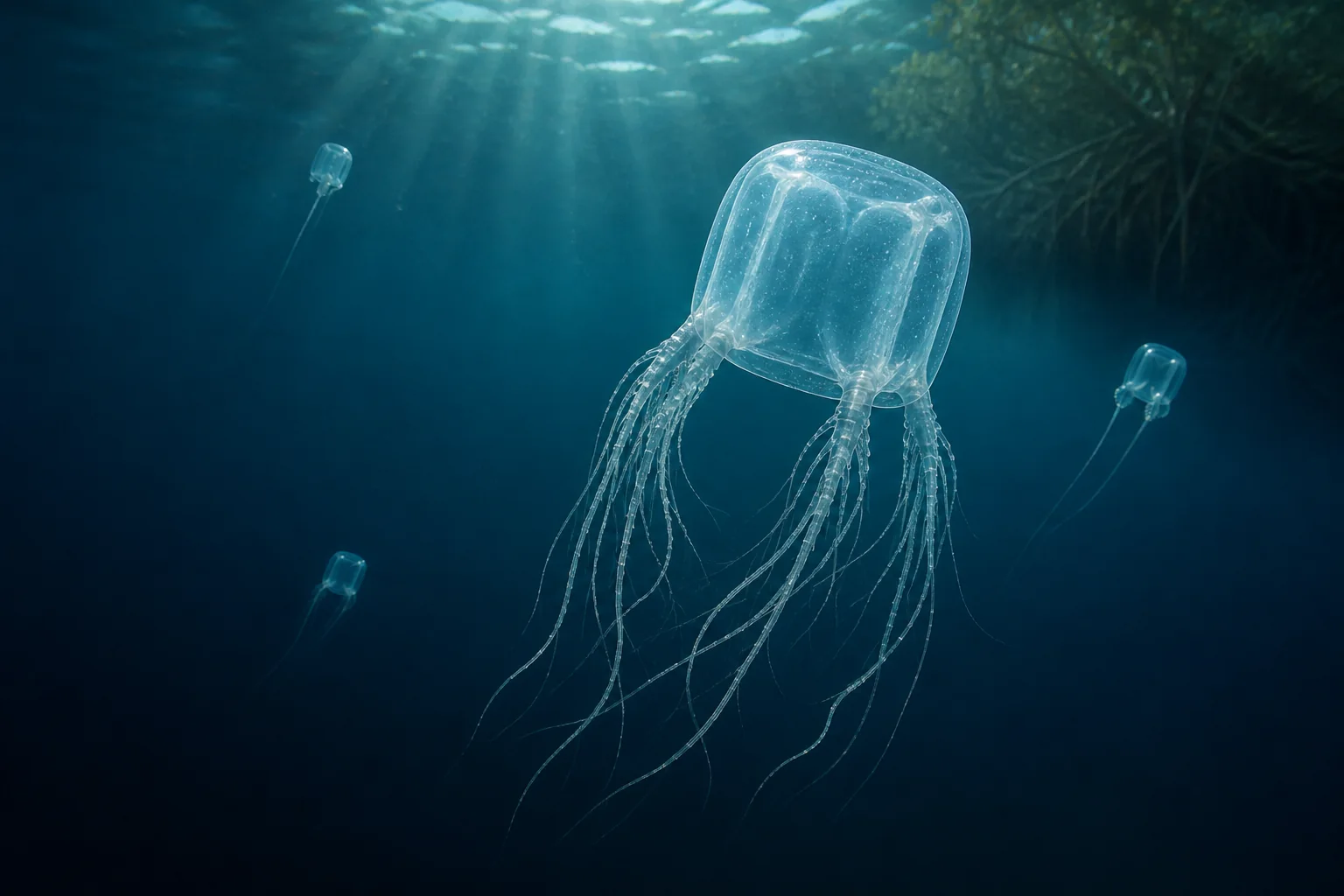
Box jellyfish venom did not evolve “to kill people.” It evolved in a predator that must stop fast-moving prey with fragile tentacles—and defend itself from threats. Human injury is an unintended collision between that system and our physiology.
Venom is a mixture
A tentacle delivers many proteins and peptides. Some disrupt cell membranes; others influence inflammation, pain or cardiovascular function. The mixture and dose differ among species, which is why “box jellyfish venom” is not one universal chemical.
Pore-forming toxin families
Genetic studies have traced expanded families of putative pore-forming toxins across medusozoans. Gene duplication and selection can produce related proteins with different expression and effects. Similar sequence does not prove identical clinical behavior.
Prey places different demands on venom
A fish-catching Chironex needs rapid immobilization; a small crustacean specialist operates at another scale. Diet, tentacle architecture and ecology can all shape selection. Direct comparative experiments are needed before an adaptive story becomes more than a plausible hypothesis.
Why evolution does not provide a danger ranking
A phylogenetic tree shows relationship, not the dose delivered in a human encounter. Medical risk also depends on tentacle contact, body size and rescue. Close relatives can differ substantially.
How a venom system changes over evolutionary time
Venom evolution is not a straight climb toward being “more deadly.” Gene duplication can create extra copies of a toxin-related gene. Mutations, expression changes and natural selection may then preserve variants that work differently in particular tissues, prey or ecological settings. Some copies can also lose their original function.
Venom, nematocysts and tentacles evolve together
The effect of a sting depends on more than a protein sequence. Nematocyst type, capsule density, tentacle architecture, discharge cues and the amount of contact determine what reaches the target. A potent molecule expressed in small quantities or in a rarely contacting structure may create a different ecological and medical outcome from the same molecule delivered across metres of tentacle.
Questions comparative studies ask
| Question | Useful evidence | Common mistake |
|---|---|---|
| Are toxin families related? | Sequence and structural comparison across species | Assuming similar sequence means identical clinical effect |
| Where is a toxin used? | Expression in tentacle, bell or life stage | Treating a whole-genome hit as delivered venom |
| What does it do? | Functional assays at realistic doses | Equating cell damage in a dish with human lethality |
| What selected for it? | Diet, ecology and phylogeny together | Writing an adaptive story without comparative tests |
Why prey matters
A fast fish, a small crustacean and a defensive predator create different selection pressures. Juvenile and adult medusae may also change prey as they grow. Researchers therefore compare species, life stages and expression rather than speaking of one fixed “box-jellyfish venom.”
Medical relevance without overclaiming
Evolutionary relationship can guide hypotheses, but it does not rank beaches or predict a patient’s outcome. Human risk depends on the named species, dose, contact area, body size and rescue. Clinical advice must come from direct medical evidence and current authorities.
Sources
Review and corrections
See an error or outdated source? Read our corrections process. Safety information is educational and does not replace local emergency services or clinical advice.