
Species profile · Last reviewed 22 August 2026
Morbakka fenneri, often called the Moreton Bay fire jelly, is an Australian box jellyfish associated with Irukandji syndrome. It is visibly larger than the tiny species that shaped the original “Irukandji jellyfish” image—one reason the syndrome should never be reduced to bell size.
Appearance and identification
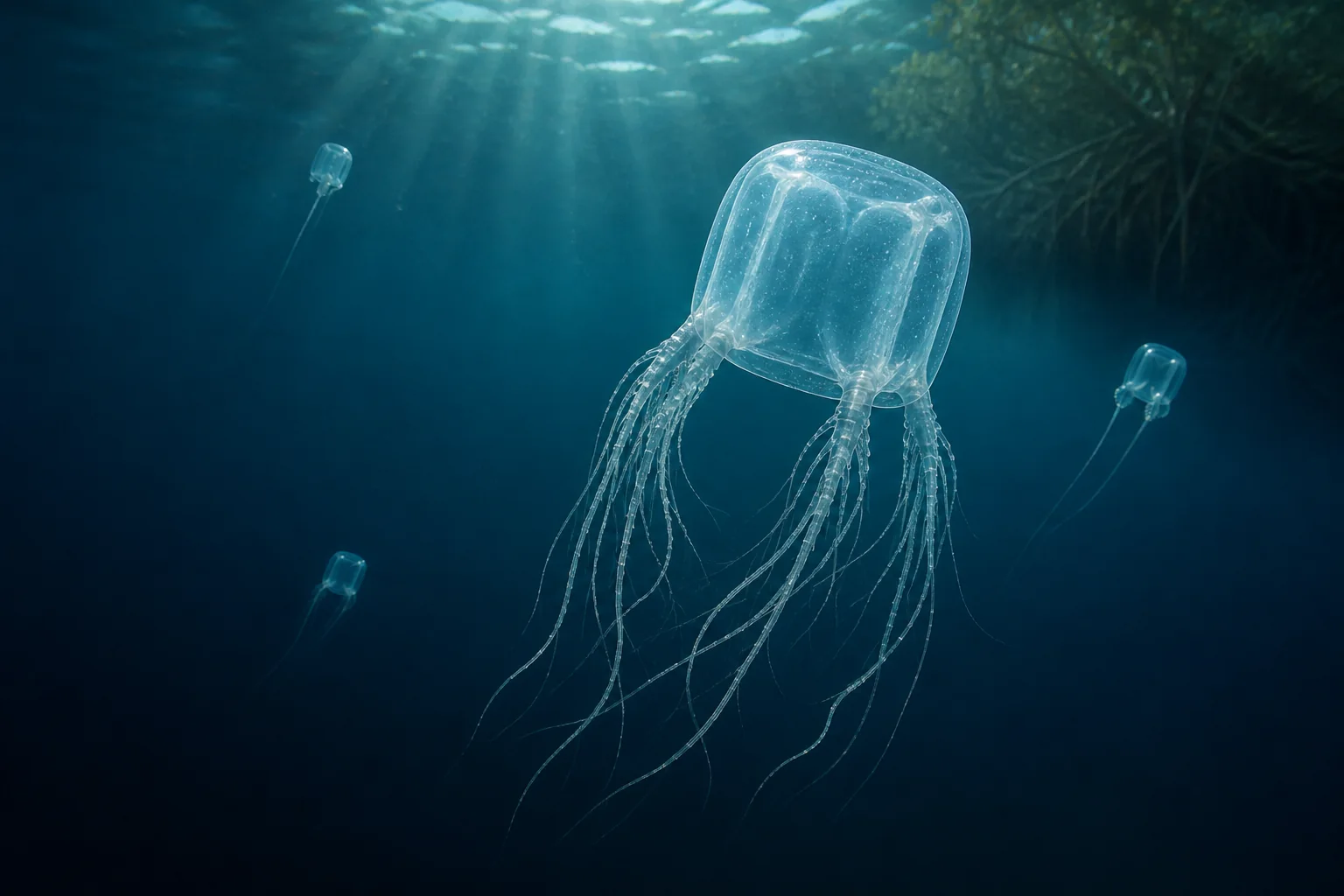
The animal has a tall box-shaped bell and four tentacles, one at each corner. Colour and size vary with condition and preservation. Confirmation relies on anatomy and locality; a photograph alone may not separate it from related carybdeids.
Known Australian range
Records include eastern and northern Australian waters, with the common name reflecting Moreton Bay in Queensland. Exact seasonal presence varies by location, and a species record is not a beach forecast.
Medical importance
Stings have been associated with Irukandji syndrome: delayed severe pain and systemic symptoms that can include sweating, nausea, agitation and cardiovascular changes. An initially modest skin mark does not rule out serious illness.
Why this species changed the conversation
Early public descriptions emphasized tiny, almost invisible Irukandji jellyfish. Morbakka fenneri demonstrated that a substantially larger animal could produce the same clinical syndrome. The more accurate framework is therefore “syndrome associated with multiple species,” not “one tiny species with one appearance.”
Species snapshot
| Accepted name | Morbakka fenneri |
|---|---|
| Order | Carybdeida |
| Common name | Moreton Bay fire jelly |
| Tentacles | One at each corner |
| Medical association | Irukandji syndrome |
Why size changed the Irukandji story
Early public descriptions centered on tiny, almost invisible jellyfish. M. fenneri is substantially larger, demonstrating that bell size cannot define the syndrome. “Irukandji” is best understood clinically as a delayed systemic pattern associated with several species.
Identification limits
A tall transparent bell and four tentacles support a broad carybdeid identification, not a confident species name. Color and body proportions change after preservation, and photographs may omit internal structures. Verified records should connect diagnostic anatomy, locality and ideally molecular data.
Range and seasonality
Records include eastern and northern Australian waters, with the common name reflecting Moreton Bay. Presence somewhere in that range does not predict a particular beach or date. Standardized local monitoring is needed to distinguish seasonal abundance from isolated observations.
Medical significance
Irukandji syndrome can begin after a delay with severe back, abdominal, chest or muscle pain, sweating, nausea, agitation and cardiovascular effects. The initial skin mark may be minor. Call emergency services for escalating or systemic symptoms after tropical-water exposure.
Research priorities
- Verified geographic and seasonal records
- Offshore movement and polyp habitat
- Prey and diel behavior
- Clinically documented cases linked to specimens
- Comparison of venom expression across life stages
Until those data improve, authoritative writing should separate confirmed species records, suspected clinical attribution and broad regional risk.
Sources
- Australian Museum: Morbakka fenneri and Irukandji syndrome
- Healthdirect Australia
- World Register of Marine Species
Medical content is editorially source-checked; independent clinical review is pending.
Review and corrections
See an error or outdated source? Read our corrections process. Safety information is educational and does not replace local emergency services or clinical advice.