
Species profile · Last reviewed 22 August 2026
Carukia barnesi is a small Australian box jellyfish with an outsized medical reputation. It is the classic species linked to Irukandji syndrome, a delayed systemic illness that may follow an initially unimpressive sting. It is not, however, the only jellyfish capable of producing that syndrome.
Identification
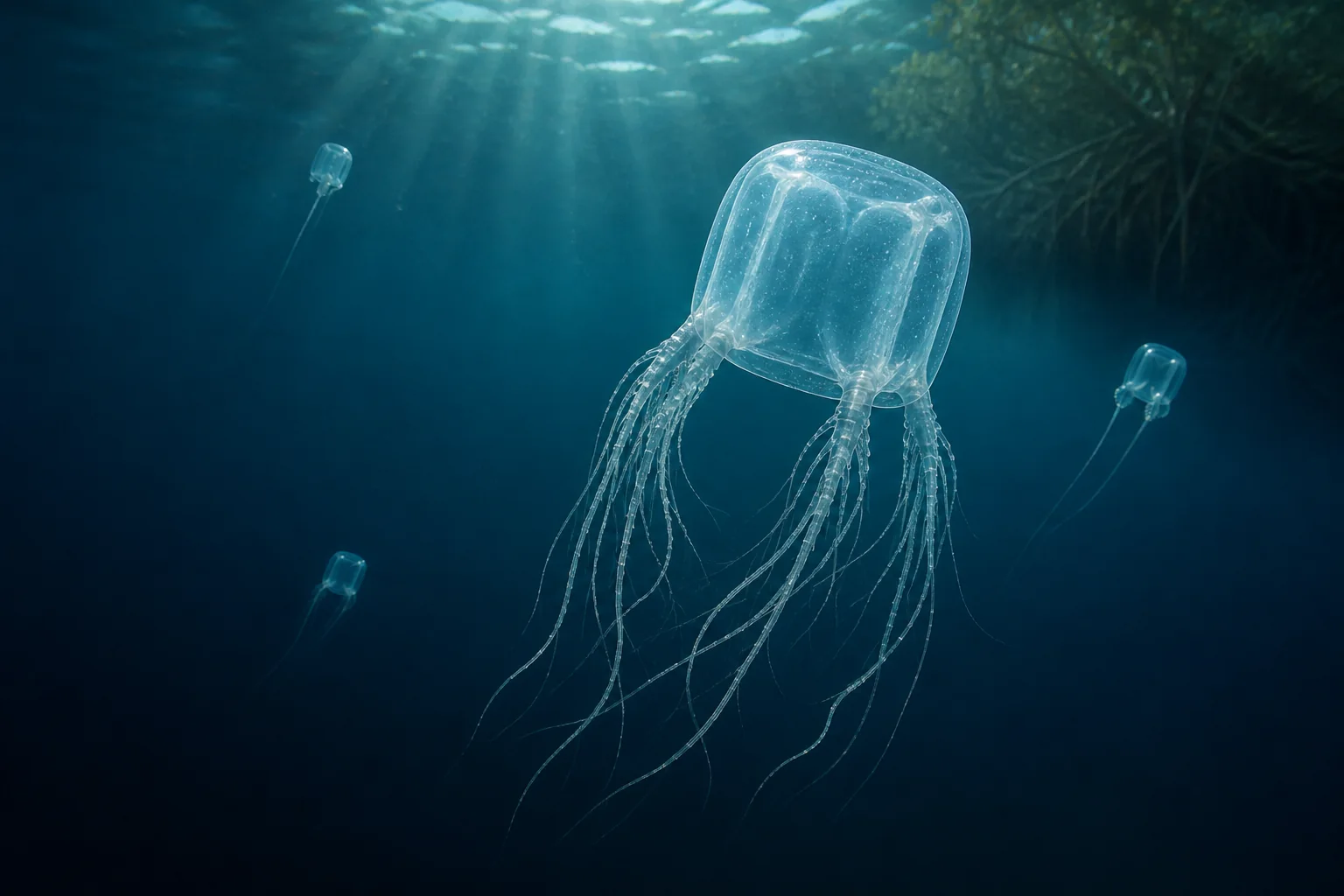
The transparent bell is only a few centimetres tall, with one slender tentacle at each of its four corners. Small reddish structures may be visible inside a fresh animal. Those clues are not a safe field test: the animal is difficult to see in water and similar carybdeids require specialist examination.
Range and habitat
Verified records are centred on tropical Australian waters. Like many small cubozoans, its offshore and near-shore movements are not fully resolved. A general map cannot predict whether a particular beach is safe on a particular day; local marine-stinger notices are the relevant source.
Why the sting can be deceptive
The first skin sensation may be mild compared with the illness that follows. After a delay, a person can develop severe back or abdominal pain, sweating, nausea, agitation, headache and dangerous cardiovascular effects. The term “Irukandji syndrome” describes that clinical pattern, not a visual identification of C. barnesi.
What researchers still want to know
Long-term abundance, the full offshore life cycle and the environmental cues behind encounters remain active questions. Sampling tiny transparent animals is hard, and clinical cases often occur without a specimen. Good research separates a confirmed animal record from a syndrome reported in the same region.
Species snapshot
| Accepted name | Carukia barnesi |
|---|---|
| Order | Carybdeida |
| Bell | Only a few centimetres tall |
| Tentacles | One slender tentacle per corner |
| Medical association | Classic species associated with Irukandji syndrome |
Why the animal is hard to detect
The bell and tentacles are transparent, the animal is small, and a swimmer may never see it. Fine internal features and locality help specialists, but an absent specimen is common in clinical cases. That is why doctors diagnose a syndrome rather than claiming a species from the skin mark.
Habitat and movement
Verified records center on tropical Australian waters. Important parts of the offshore life and movement toward beaches remain incompletely resolved. Weather, currents and seasonal observations can guide monitoring, but no single cue proves a beach is safe.
Irukandji syndrome timeline
| Phase | Possible presentation |
|---|---|
| Initial sting | Mild pain or a small, inconspicuous mark |
| Delayed phase | Severe back, abdominal, chest or muscle pain; sweating; nausea; agitation; headache |
| Severe complications | Marked cardiovascular effects requiring urgent hospital care |
The syndrome is associated with several species. A patient with the pattern did not necessarily encounter C. barnesi.
Research methods
Scientists use light traps, targeted sampling, laboratory observation, morphology, molecular identification and clinical surveillance. Each method samples a different part of the problem: animals in the water, taxonomic identity or human illness.
Unanswered questions
- Where do wild polyps persist?
- What controls offshore and near-shore movement?
- How does abundance change across years?
- Which clinical cases can be tied to collected specimens?
- How do venom profiles differ among syndrome-associated species?
Suspected Irukandji syndrome is an emergency. Do not wait for a dramatic welt or a species identification.
Sources
- Australian Museum: Irukandji-associated jellyfish
- Healthdirect Australia: jellyfish stings
- World Register of Marine Species
Medical content is editorially source-checked; independent clinical review is pending.
Review and corrections
See an error or outdated source? Read our corrections process. Safety information is educational and does not replace local emergency services or clinical advice.