
Anatomy close-up · Last reviewed 22 August 2026

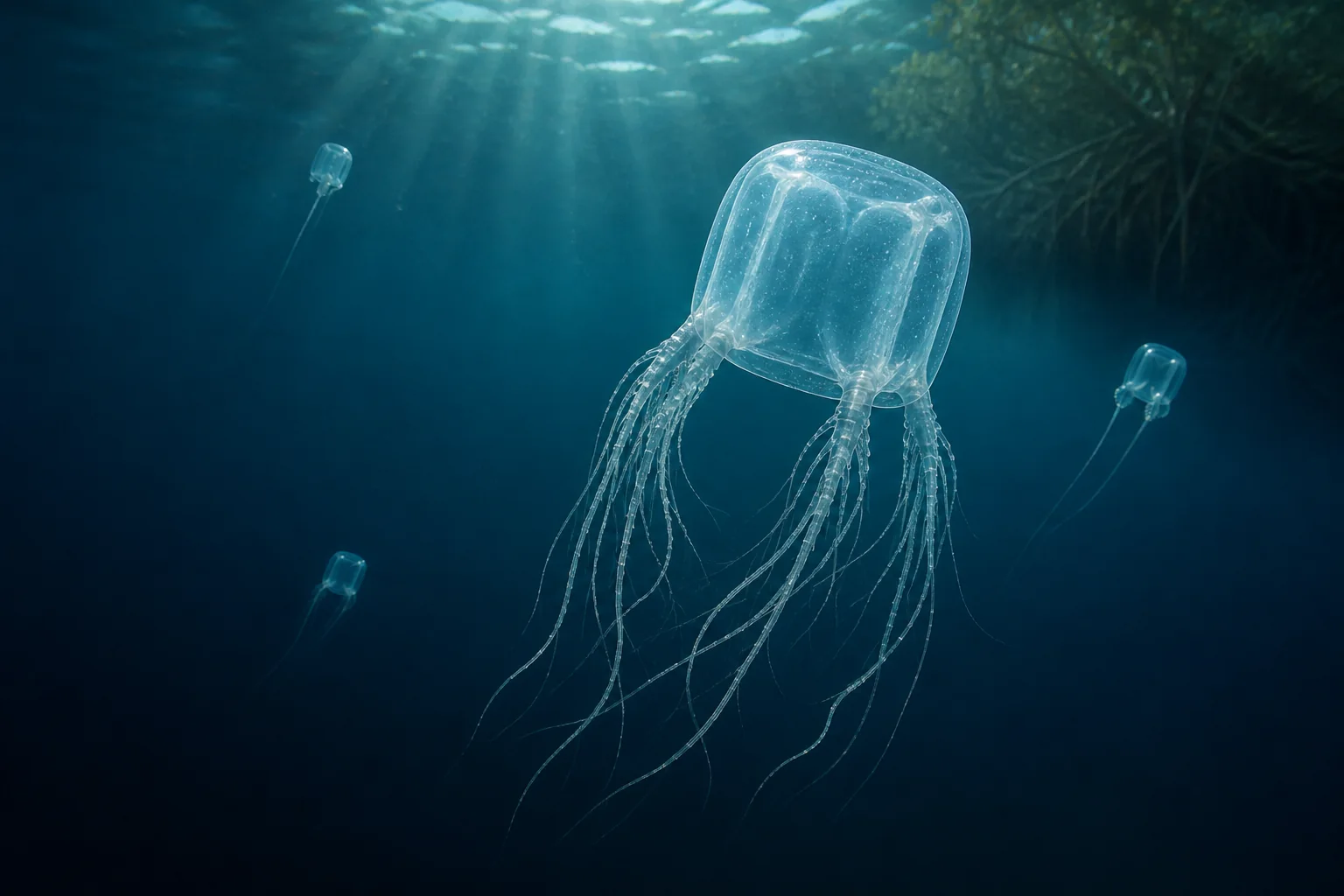
A box jellyfish does not bite. Its tentacles carry vast numbers of microscopic capsules called nematocysts. Each capsule contains a tightly packed tubule that can turn outward at extraordinary speed, pierce or wrap around tissue and deliver venom. The whole event is over long before a hand can pull away.
One sting, step by step
- Contact and chemical cues: mechanical contact and the chemistry of a surface contribute to activation.
- Capsule discharge: pressure drives the coiled tubule outward in a rapid eversion.
- Attachment or penetration: structures on the tubule help it grip or enter tissue.
- Venom delivery: venom components reach the tissue and begin their biological effects.
The familiar “harpoon” analogy is helpful but incomplete. Nematocysts come in different shapes and perform different jobs, from penetrating prey to entangling it.
A nematocyst is not the whole cell
The stinging cell is a cnidocyte; the pressure-packed capsule inside it is the nematocyst. People often use the words interchangeably, but the distinction matters when reading microscopy and venom research.
Why tentacles can sting after detaching
Discharge does not require a command from a brain. Local cellular mechanisms can remain functional in detached tentacle fragments and stranded animals. That is why a jellyfish that looks dead—or a nearly invisible thread on fishing gear—should not be touched with bare skin.
Why fresh water is a problem in first aid
Changing the salt balance around unfired stinging cells can promote discharge in some medically important jellyfish. Current Australian guidance therefore says to use seawater, not fresh water, when rinsing remaining tentacles. This is about cells that have not yet fired; it does not “wash venom out” of tissue.
How scientists study firing
Researchers use high-speed imaging, microscopy, isolated tentacles and laboratory models. These methods can show whether an intervention changes discharge under controlled conditions, but a promising experiment is not automatically a public first-aid recommendation. Real-world protocols must weigh human outcomes, different species and the risk of delaying resuscitation.
What venom does after delivery
Box jellyfish venom is a mixture rather than a single toxin. Its components can affect cell membranes, inflammation, pain and—depending on the species and dose—the cardiovascular system. The severe effects of Chironex fleckeri should not be copied wholesale onto every cubozoan.
Useful questions
Can sunscreen stop nematocysts?
Ordinary sunscreen is not a substitute for protective clothing or local warnings. Some products make specific anti-sting claims, but evidence and species coverage vary.
Can a tentacle fire more than once?
Each individual capsule is single-use, but a tentacle contains enormous numbers of capsules. Contact can expose the skin to many unfired nematocysts.
Why not rub the sting?
Rubbing can increase mechanical stimulation and spread tentacle material. Follow local first-aid guidance and remove remaining tentacles using the recommended method.
Sources
Review and corrections
See an error or outdated source? Read our corrections process. Safety information is educational and does not replace local emergency services or clinical advice.