
Beach safety checklist · Last reviewed 22 August 2026

You cannot make tropical seawater risk-free, but you can remove much of the guesswork. The best protection is layered: current local advice, a sensible swimming location, full-coverage clothing and a plan for emergencies.

Before you enter the water
- Check today’s local warning. Look for beach closures, marine-stinger notices and lifeguard advice—not a generic “jellyfish season” calendar.
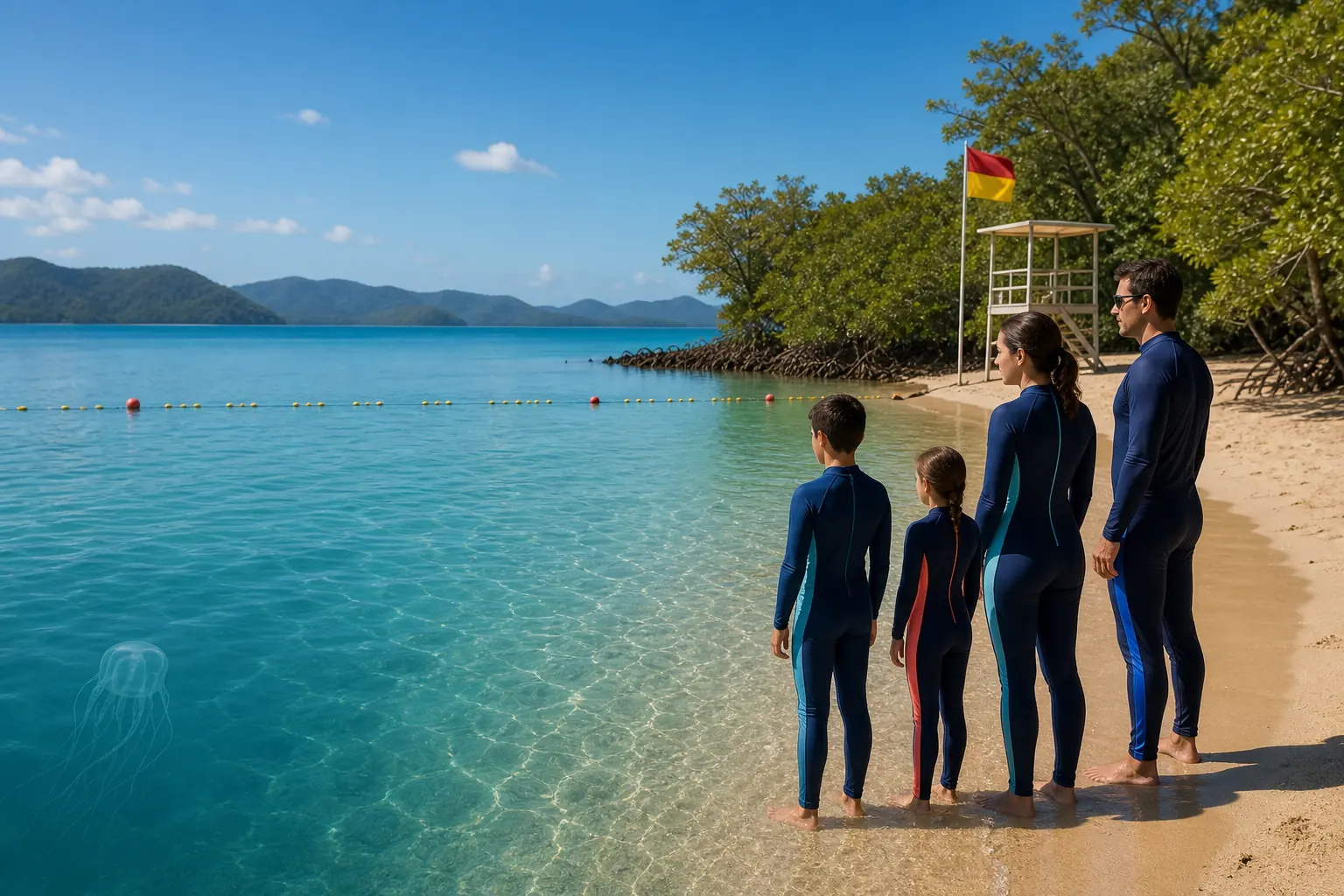
- Choose a patrolled location. Swim between the designated flags and inside a maintained enclosure where local authorities provide one.
- Ask what protection is recommended. Conditions differ between northern Australia, Hawaii, Southeast Asia and the Caribbean.
- Know the emergency number. Check the location of lifesaving equipment and vinegar stations where those form part of the local protocol.
Wear a real coverage layer
A full-body stinger suit creates a physical barrier between tentacles and skin. Fit matters: uncovered ankles, wrists, necks, faces and hands remain exposed. A standard swimsuit, thin patchy clothing or sunscreen alone does not provide comparable coverage.
What enclosures can—and cannot—do
Marine-stinger enclosures are designed to reduce entry by local jellyfish and to define a managed swimming area. They are not force fields. Tiny animals or tentacle fragments may pass through some mesh, and damage or weather can affect protection. Follow the sign at that beach.
Conditions that deserve extra caution
Local authorities may restrict swimming during a known season, after sightings or under particular weather and tidal conditions. There is no single wind, tide, moon phase or water temperature that predicts box jellyfish everywhere. If locals close the water, the responsible choice is to stay out.
Children, dogs and shoreline exploring
Children have less body mass and may be at greater risk from the same venom exposure. Keep them close and fully covered in designated areas. Do not let children or pets investigate transparent animals, tentacle fragments or jelly-like material on the sand. Stranded animals can still sting.
If you see a possible box jellyfish
- Leave the water calmly and alert the lifeguard or local authority.
- Keep other people away; do not attempt a bare-handed rescue or collection.
- Photograph it only from a safe distance.
- Do not assume one sighting proves the whole coast is unsafe—or that no sighting proves it is safe.
Make a 60-second beach plan
Before swimming
Current warning checked; patrol or enclosure identified; protective suit fitted; children briefed; emergency number and exit point known.
If a sting occurs
Get the person out of the water, call emergency services, begin CPR if unresponsive and not breathing normally, and follow current local first-aid guidance. Do not use fresh water on remaining marine-jellyfish tentacles.
Sources and review
- Healthdirect Australia: jellyfish stings
- WorkSafe Queensland: marine stingers
- Northern Territory Government: box jellyfish
Safety content is editorially source-checked; independent clinical review is pending.
Review and corrections
See an error or outdated source? Read our corrections process. Safety information is educational and does not replace local emergency services or clinical advice.