
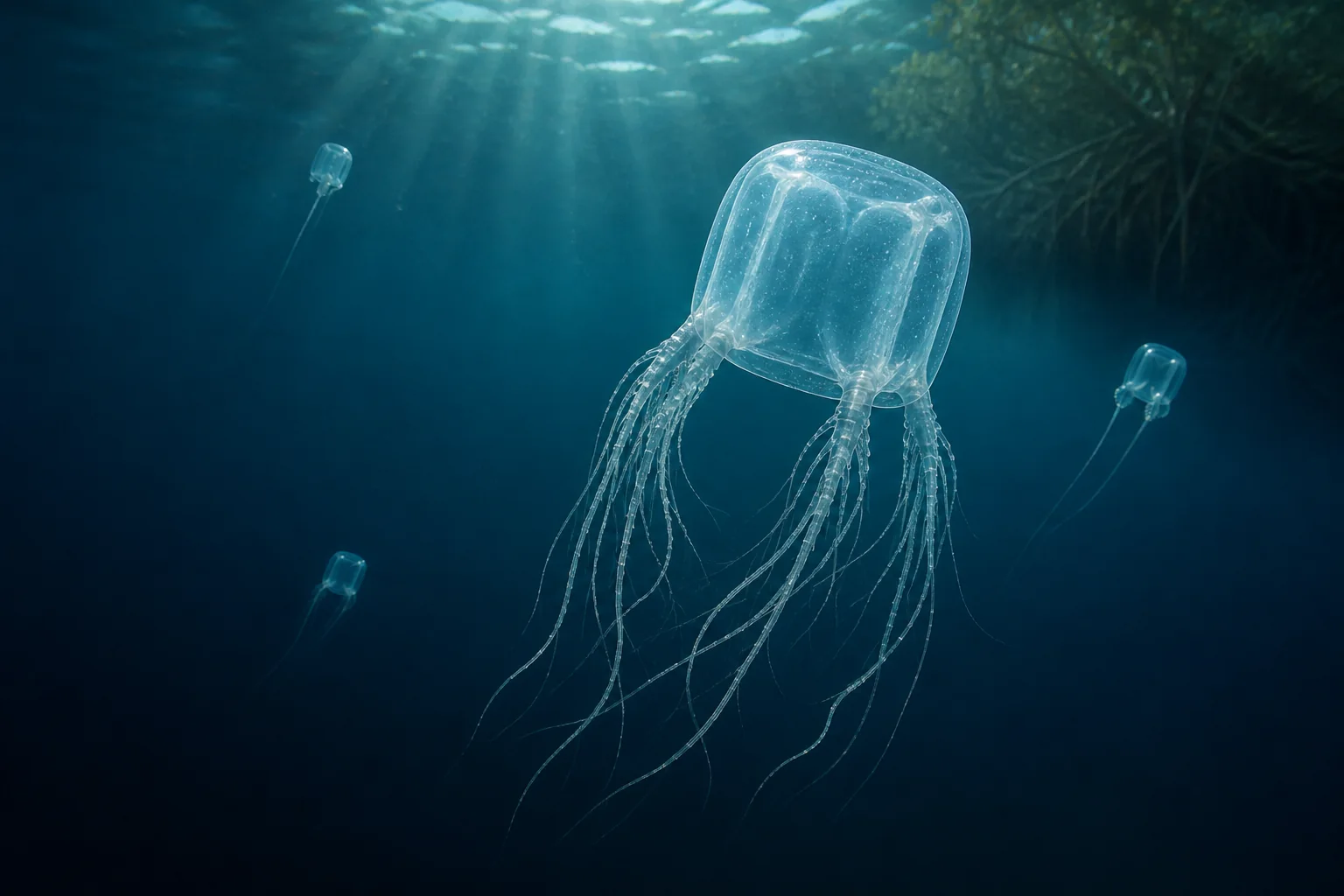
Behavior FAQ · Last reviewed 22 August 2026
Scientists have not established a human-like sleep state for box jellyfish. They do show changing activity, pauses and rhythms, but immobility alone is not enough to call an animal asleep.
What counts as sleep?
Researchers usually look for a reversible period of reduced activity, decreased responsiveness and a rebound after deprivation. Those tests have identified sleep-like states in some jellyfish, notably the upside-down jellyfish Cassiopea. Evidence from one cnidarian cannot simply be assigned to every cubozoan.
Why a resting box jellyfish is hard to interpret
Swimming pulses change with light, sensory input and the interaction of rhopalial pacemakers. A quiet animal may be conserving energy, responding to darkness, attached to a surface in a species that does so, or stressed in a laboratory tank.
Do they have a day-night rhythm?
Some species have strong daily or lunar activity patterns. Copula sivickisi can attach to surfaces, while Alatina alata makes timed reproductive migrations. A biological rhythm is not automatically sleep.
The honest answer
Box jellyfish probably have low-activity states, but whether those states meet experimental sleep criteria across Cubozoa remains unresolved. A good future study would measure responsiveness and rebound, not only film an animal pausing.
Sleep, rest and biological rhythm are different claims
| Observation | What it can show | What it cannot prove alone |
|---|---|---|
| Reduced swimming at night | A daily activity rhythm | Sleep |
| Temporary attachment to a surface | Species-specific resting behavior | Reduced responsiveness |
| Slower response to a stimulus | A sleep-like criterion | Homeostatic sleep without deprivation testing |
| Rebound after deprivation | Evidence of sleep pressure | Human-like dreams or consciousness |
What other jellyfish research tells us
Experiments on the upside-down jellyfish Cassiopea have reported sleep-like behavior using reduced activity, reduced responsiveness and rebound after disturbance. That result is important because it shows a cnidarian can meet operational sleep criteria. It does not establish the same state in every cubozoan.
Why box jellyfish are an interesting test
Box jellyfish combine distributed nerves with four rhopalia that contain eyes and swim pacemakers. Light, prey, obstacles and the interaction among pacemakers can all change pulse rate. A convincing experiment must separate ordinary sensory responses and stress from a reversible internally regulated state.
How scientists could test the question
- Measure activity across repeated light-dark cycles.
- Deliver the same mild stimulus during active and quiet periods.
- Confirm that the quiet state reverses quickly when conditions demand it.
- Disrupt the quiet period without physically damaging the animal.
- Look for compensatory rebound afterward.
- Repeat the work across species rather than generalizing from one laboratory animal.
Frequently asked questions
Do box jellyfish close their eyes?
No eyelid-based test applies. Their eyes are embedded in rhopalia and do not close like vertebrate eyes.
Does floating motionless mean sleep?
No. The animal may be responding to darkness, conserving energy, stressed or simply carried by water movement.
What is the best current answer?
Box jellyfish have activity rhythms and low-activity states, but a sleep state across Cubozoa has not yet been established with the full experimental criteria.
Sources
Review and corrections
See an error or outdated source? Read our corrections process. Safety information is educational and does not replace local emergency services or clinical advice.