
Identification comparison · Last reviewed 22 August 2026

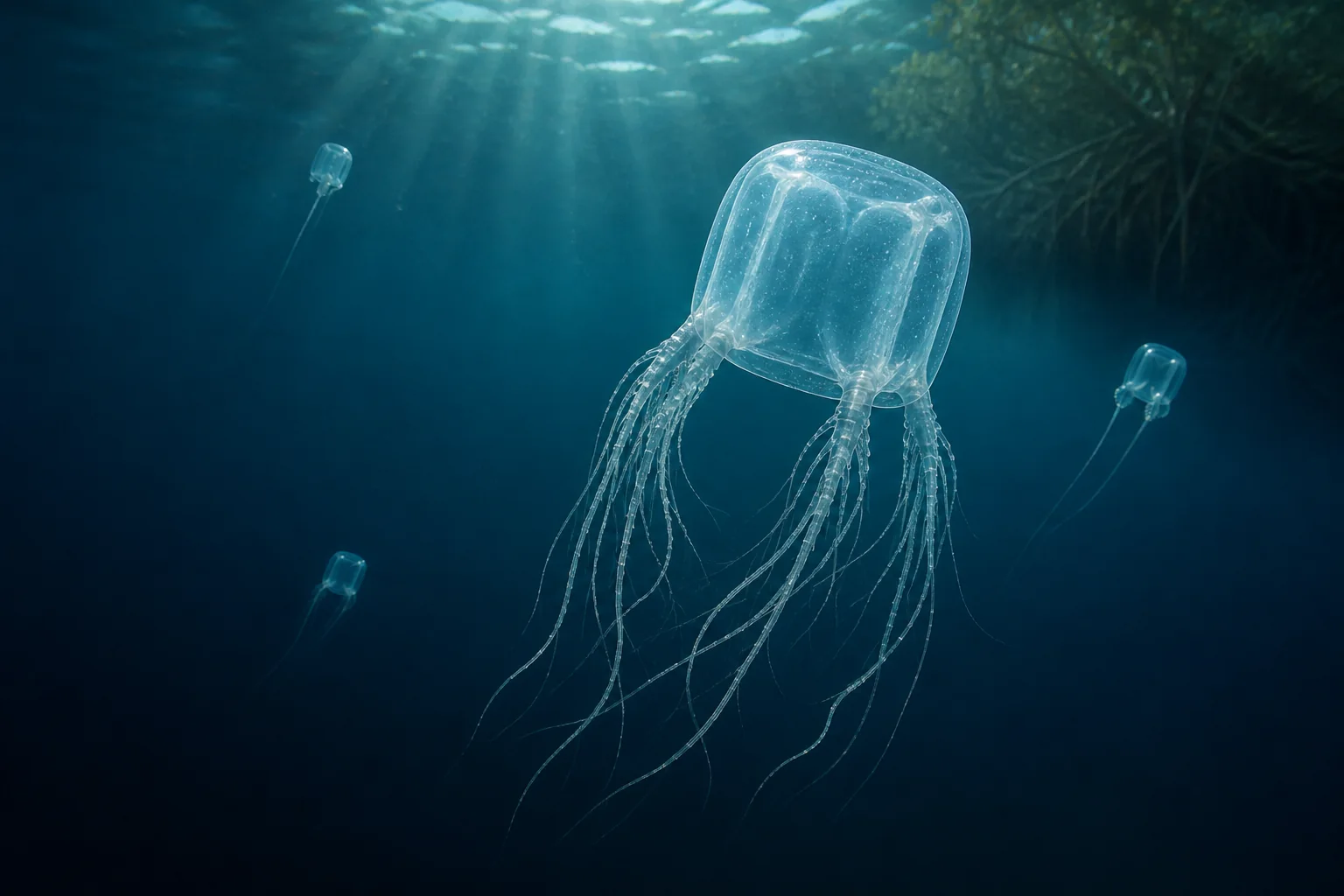
A box jellyfish is one animal. A Portuguese man o’ war is a floating colony of specialized organisms called zooids working together. Both can trail dangerous tentacles, but their shape, biology and arrival patterns are unmistakably different when seen clearly.
| Feature | Box jellyfish | Portuguese man o’ war |
|---|---|---|
| Animal type | Cubozoan medusa | Siphonophore colony |
| Visible body | Transparent, submerged box-like bell | Blue-purple gas float at the surface |
| Movement | Actively swims and steers | Driven largely by wind and current |
| Tentacles | Hang from four bell corners | Trail below the surface float |
Why the distinction matters
Public-health first aid can differ by species and region. In Hawaii, for example, box jellyfish arrivals have a lunar pattern on some shores, while man o’ war strandings are often associated with strong onshore winds. Do not copy a treatment from a photo caption.
What they share
Both have nematocysts, both can sting after stranding and neither should be handled. Severe pain, breathing difficulty, collapse or systemic symptoms require emergency care.
Identification from a safe distance
The float is the easiest distinction. A Portuguese man o’ war has a blue, violet or pink gas-filled float that sits above the surface like a small sail. A box jellyfish is mostly submerged and may be extremely difficult to see because its bell is transparent. Never enter the water or handle a stranded animal to confirm an identification.
How their movement differs
Box jellyfish contract a muscular bell and can steer. A man o’ war has no bell and cannot swim in the same way; its float and sail make wind a major influence on where the colony travels and strands. Currents affect both animals, so movement alone is not a perfect field test.
Tentacles and stranded material
Both can retain active nematocysts after stranding. A man o’ war’s long tentacles may be separated from the obvious float, while transparent box-jellyfish tentacles can be difficult to see on sand or fishing gear. Keep children and dogs away and notify a lifeguard or responsible coastal authority.
Common questions
Which one is more dangerous?
Risk depends on species, exposure and location. Some box jellyfish can cause rapid life-threatening illness; man o’ war stings are commonly very painful and can occasionally produce severe systemic reactions. A comparison page cannot determine whether a particular sting is safe to observe at home.
Can first aid be the same?
Do not assume so. Public guidance differs by animal and region. For example, Hawaii Ocean Safety distinguishes box-jellyfish arrival patterns from wind-driven man o’ war events. Follow the local dispatcher or beach authority.
What photograph is most useful?
From a safe distance, record the whole animal, the surface float if present, bell shape, tentacle arrangement, date and exact location. A geolocated wide photograph is often more useful than a close crop without context.
Sources
Independent clinical review is pending.
Review and corrections
See an error or outdated source? Read our corrections process. Safety information is educational and does not replace local emergency services or clinical advice.