
Identification comparison · Last reviewed 22 August 2026

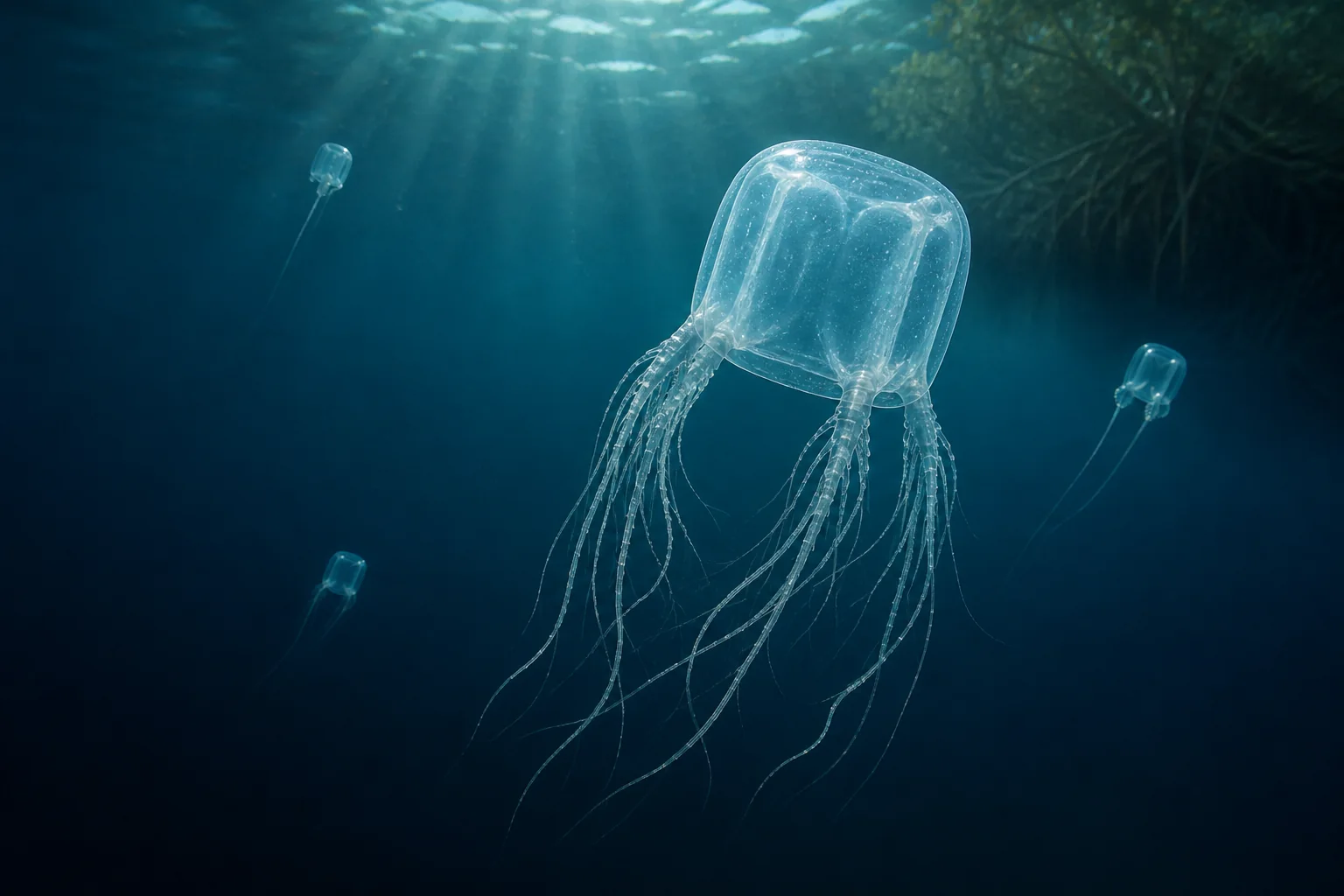
Box jellyfish and moon jellyfish are both cnidarians, but they belong to different classes and move through the sea in very different ways. The quickest visual contrast is a cube-like, purposeful swimmer versus a round, saucer-like drifter with four horseshoe-shaped gonads often visible through the bell.
| Feature | Box jellyfish | Moon jellyfish |
|---|---|---|
| Class | Cubozoa | Scyphozoa |
| Bell | Roughly four-sided | Round, shallow saucer |
| Eyes | 24 eyes on four rhopalia in many species | Simple light-sensing structures |
| Swimming | Strong jetting and active steering | Rhythmic pulsing, more influenced by currents |
| Sting | Ranges from mild to life-threatening by species | Usually mild to people, though reactions vary |
Do not identify by danger
A painful sting does not prove the animal was a box jellyfish, and a transparent bell does not rule one in. Regional species, tentacle pattern and a clear photograph are more useful.
Four circles versus four corners
The four pale or purple horseshoes visible in many adult moon jellies are reproductive organs inside a circular bell. They are not the four corners of a cube. A box jellyfish’s tentacles emerge from muscular pedalia at the lower corners.
Body plan and life cycle
Moon jellyfish belong to Scyphozoa, the group often called true jellyfish. Box jellyfish form the separate class Cubozoa. Both have a swimming medusa and an attached polyp stage, but cubozoan polyps generally transform into one juvenile medusa rather than producing the familiar stack of discs seen in many scyphozoans.
How to compare them in the water
- Outline: moon jellies are round and saucer-like; a cubozoan bell has four sides and corners.
- Internal pattern: four horseshoe-shaped gonads are often visible in an adult moon jelly.
- Tentacle origin: box-jellyfish tentacles arise from muscular pedalia at the four lower corners.
- Swimming: moon jellies pulse but are more influenced by currents; cubozoans can generate directed jets and turn.
Visibility, damage and juvenile size can hide these features. Do not touch an animal to inspect it.
Why a photograph matters
A useful identification image includes the entire bell, the lower margin and tentacle bases, not only a patch of transparent tissue. Record the coast and date because the credible candidate species differ by region. A photograph can support a cautious group-level identification, but diagnostic anatomy may be required for species.
Frequently asked questions
Are moon jellyfish harmless?
They are generally associated with mild effects in people, but reactions vary and an uncertain animal should not be handled. “Usually mild” is not the same as universally harmless.
Does a square shape prove it is dangerous?
No. A box-like bell supports identification as a cubozoan; medical importance still depends on the species and exposure.
Can both appear on the same beach?
Yes. Coastal currents and seasonal conditions can bring several gelatinous species into the same area. Use local observations rather than treating one sighting as evidence about every jellyfish present.
Sources
Review and corrections
See an error or outdated source? Read our corrections process. Safety information is educational and does not replace local emergency services or clinical advice.